
Last updated July 15, 2026
Air Duct Cleaning Permits, Codes & Inspections in NY: What You Need to Know
Here’s the counterintuitive truth we’ve learned crawling through thousands of Buffalo duct systems: the cleaning itself almost never needs a permit, but it’s what you find during cleaning that creates liability. In our 8 years serving Buffalo, we’ve stopped mid-job more times than we can count—mold behind a trunk line in North Buffalo, asbestos-wrapped ducts in a pre-war Kenmore colonial, a previous contractor’s unpermitted HVAC addition in Amherst that voided the homeowner’s insurance. The contractor who finds mold in your ducts and offers to remediate it on the same visit without pulling a separate remediation scope is either unqualified, unlicensed for that work, or both. This guide—along with The Complete Guide to Air Duct Cleaning in Buffalo—draws the exact line between cleaning and permit territory so you don’t end up liable for someone else’s corner-cutting.
Quick Answer
Our Air Duct Cleaning services alone do not require a permit in New York State. However, if cleaning reveals or connects to mold remediation, asbestos abatement, duct replacement, or HVAC mechanical modifications, separate licensing and permits become mandatory—and continuing work without them can leave Buffalo homeowners financially liable and void their insurance coverage.
Table of Contents
- Cleaning vs. Remediation: Where the Permit Line Lives
- New York Mold Licensing Requirements for Duct Contractors
- Erie County & Buffalo Mechanical Permit Rules for Duct Work
- Asbestos Awareness in Pre-1980 Buffalo Homes
- How to Protect Yourself Contractually
- When Inspections Get Triggered in Practice
- Common Mistakes to Avoid
- When to Call a Professional
- Frequently Asked Questions
Cleaning vs. Remediation: Where the Permit Line Lives
The New York State Department of Labor and local building codes distinguish sharply between cleaning and remediation—and most homeowners don’t learn the difference until it’s too expensive to fix.
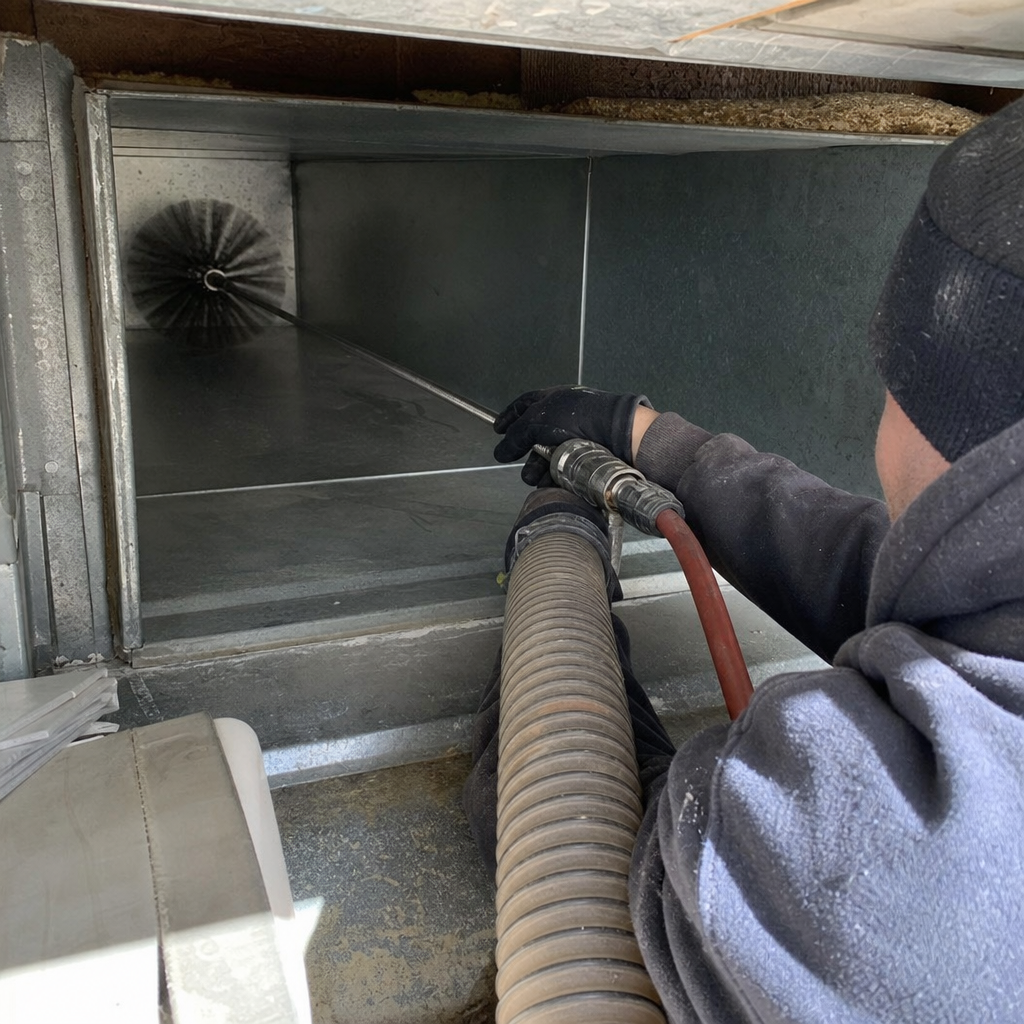
Cleaning (no permit required): Mechanical removal of dust, debris, and surface contaminants using negative air pressure, agitation tools, and vacuum extraction. This is what we do with our Rotobrush and Abatement Technologies systems—physical cleaning of accessible duct interiors without altering the system, applying biocides that claim remediation, or disturbing structural materials.
Remediation (permits and licensing required): Any activity that addresses mold growth, asbestos-containing materials, or modifies the duct system’s structure, capacity, or connection to HVAC equipment. This includes:
- Mold treatment beyond surface cleaning—applying EPA-registered biocides that claim to kill or inhibit mold growth
- Removal or disturbance of asbestos-containing duct insulation or wrap
- Replacement of duct sections, plenums, or trunk lines
- Sealing or modifying connections to furnaces, air handlers, or ventilation equipment
- Installation of new duct runs or registers
In Buffalo’s climate, this distinction matters intensely. Our freeze-thaw cycles, lake-effect humidity, and older housing stock create conditions where surface cleaning frequently reveals deeper problems. We’ve opened systems in Riverside and Lovejoy where decades of moisture behind fiberglass liner had created active mold colonies—not surface dust, but colonized substrate. At that moment, our job stops. We’re equipped with professional-grade equipment for cleaning, not licensed for mold remediation. Anyone who blurs that line is putting you at risk.
The Pinnacle Air Duct Cleaning Service Greater Buffalo home page outlines our exact scope, and we separate it deliberately.
New York Mold Licensing Requirements for Duct Contractors
New York is one of the few states with comprehensive mold licensing laws, and they’re frequently violated by duct cleaners who don’t know—or don’t care—about the boundaries.
The legal framework: Article 32 of the New York State Labor Law requires separate licenses for mold assessment and mold remediation. These are not add-on certifications. They require specific training, examination, and insurance that standard duct cleaning credentials do not include.
- Mold Assessor License: Required to identify mold, develop remediation plans, and conduct post-remediation clearance. A duct cleaner who “diagnoses” mold growth during an inspection and recommends treatment needs this license—or needs to refer to someone who has it.
- Mold Remediation Contractor License: Required to perform mold abatement work, including in duct systems. This includes applying products that claim to kill, remove, or prevent mold growth beyond standard cleaning.
- Mold Abatement Worker License: Required for individuals performing remediation under a licensed contractor.
Here’s what this means practically: if a Buffalo duct cleaner opens your system, points to dark staining, and offers to “treat” or “remediate” it with a chemical fog or coating, they’re performing mold remediation without a license unless they hold Article 32 credentials. We’ve seen this repeatedly—franchise crews with weekend certifications offering “mold treatment” as an upsell. It’s illegal, and if something goes wrong, your recourse is limited.
Our approach at Air Duct Cleaning in Buffalo is straightforward: we document what we see, stop at the boundary of our licensed scope, and refer you to properly credentialed assessors and remediators. Charles handles every job personally, and that includes knowing when not to proceed.
Erie County & Buffalo Mechanical Permit Rules for Duct Work
While cleaning doesn’t trigger permits, the moment duct work connects to mechanical system changes, Erie County and City of Buffalo building departments get involved.
When mechanical permits apply:
- HVAC replacement or addition: Installing a new furnace, air handler, or central air system requires a mechanical permit. If duct modifications are part of that project—resizing trunk lines, adding returns, relocating registers—the duct work falls under the same permit.
- Duct replacement exceeding 50% of system: While interpretations vary by inspector, replacing the majority of a duct system typically requires permitting as it constitutes a “modification” to the mechanical system.
- Converting unconditioned space: Adding ducts to a finished basement, attic conversion, or addition in Buffalo’s West Side or Elmwood Village often requires both mechanical and building permits.
- Changing system capacity: Any duct modification that alters CFM ratings or system static pressure may require engineering review.
Buffalo-specific context: The City of Buffalo’s Division of Permit & Inspection Services enforces the New York State Uniform Fire Prevention and Building Code (Uniform Code) and Energy Conservation Construction Code. Erie County towns and villages—Amherst, Cheektowaga, Tonawanda—may have additional requirements through their own building departments. In our experience, Buffalo’s older housing stock creates particular friction: a 1920s Tudor in Delaware District with original gravity-heat ducts being converted to forced air needs careful permitting, while a 1990s Hamburg ranch with straightforward cleaning needs none.
We’ve worked alongside permitted HVAC contractors on jobs where cleaning revealed the need for system modification. We don’t perform that work—we coordinate with licensed mechanical contractors who pull proper permits, then return to clean the modified system once it’s approved.
Asbestos Awareness in Pre-1980 Buffalo Homes
This is where Buffalo’s housing age becomes a legal and safety minefield that out-of-town franchise crews often miss entirely.
The regulatory trigger: New York State Department of Labor regulations (12 NYCRR Part 56) and EPA NESHAP standards require asbestos inspection before disturbing building materials in structures built before 1980. This includes:
- Asbestos-containing duct tape and joint compound
- Vermiculite insulation in duct chases or plenums
- Asbestos paper or cardboard duct lining
- Transite (asbestos-cement) vent pipes connected to heating systems
When we must stop work: If our Rotobrush or Nikro equipment encounters suspect material—friable gray tape on duct seams, white fibrous lining that crumbles, or vermiculite spillage—we’re legally required to cease disturbance immediately. We cannot legally remove it. We cannot legally test it ourselves (that requires a separate NYS-certified asbestos inspector). We must refer you to a licensed asbestos abatement contractor.
In Buffalo’s pre-war neighborhoods—North Buffalo, Parkside, the Fruit Belt, much of South Buffalo—we encounter this regularly. A 2019 job in a Kaisertown duplex: our brush hit degraded duct tape that tested positive for chrysotile. The homeowner’s previous cleaner had apparently brushed right past it. We stopped, documented, referred. The abatement contractor pulled proper permits, completed removal, and we returned to finish cleaning the replaced ducts.
The penalty for getting this wrong is severe: improper asbestos disturbance carries NYS fines up to $10,000 per day, and homeowners can be held liable for contractor violations on their property. “I didn’t know” is not a defense that holds up.
How to Protect Yourself Contractually
We’ve learned through 8 years and 160 customer reviews that the best protection is documentation before the first tool enters your duct. Here’s what we recommend every Buffalo homeowner require:
- Written scope with explicit boundaries: The contract should state exactly what constitutes “cleaning” versus what triggers additional licensing. Ours specifies: “Mechanical cleaning of accessible duct interiors only. Mold remediation, asbestos abatement, and duct modification are outside scope and require separate licensed contractors.”
- Stop-work protocol: Require written confirmation of what happens when the contractor encounters mold, asbestos, or structural damage. Will they stop? Document? Refer? Or—red flag—offer to handle it themselves?
- Insurance verification without invented numbers: Request certificate of insurance showing general liability and workers’ compensation. Don’t accept “fully insured” as language; request the document. (We provide this on request; we do not publish policy numbers due to fraud risk.)
- Equipment specification: The contract should name the actual equipment to be used. “Professional-grade negative air system” means nothing. “Rotobrush Roto-Vision 360 with HEPA filtration” or “Abatement Technologies HEPA-AIRE portable power vacuum” is verifiable.
- Photo documentation requirement: Before-and-after imaging protects both parties. We photograph every trunk line, return, and major branch—partly for our 4.9-star quality control, partly so homeowners have evidence if permit-related issues arise later.
In our experience, the contractors who resist written scope boundaries are the ones most likely to blur into unlicensed remediation. Charles handles every job personally, and our contracts reflect that direct accountability.
When Inspections Get Triggered in Practice
Most Buffalo homeowners assume inspections only happen when you call for them. In reality, duct-related inspections get triggered multiple ways:
Complaint-driven inspections: Neighbor reports visible mold discharge, asbestos debris, or improper venting. Buffalo’s dense neighborhoods—Allentown, the Lower West Side—increase this risk; a remediation crew without containment affects adjacent properties.
Insurance claim follow-up: If you file a claim for water damage, fire, or health issues and mention duct work, your insurer may require permit verification. Unpermitted remediation discovered during this process can void coverage.
Property sale disclosures: Buffalo’s hot real estate market means more transactions—and more buyer inspections that uncover unpermitted work. We’ve been called to clean systems where the seller’s “duct cleaning” from three years prior was actually unpermitted mold remediation, now flagged by the buyer’s inspector.
HVAC contractor red-flag: When a properly licensed HVAC contractor encounters previous unpermitted duct modification, they’re required to report it or refuse to connect new equipment until it’s rectified.
The pattern: unpermitted work doesn’t stay hidden. It surfaces at the most expensive possible moment.
Common Mistakes to Avoid
- Hiring a “one-stop shop” that claims to clean, remediate, and replace: In New York, the same entity cannot legally perform mold assessment and remediation on the same job. A contractor offering all three is either unaware of Article 32 or ignoring it.
- Accepting verbal assurances about permits: “We pull permits when needed” means nothing without specifics. Ask: “For this exact scope, which permits apply, and who pulls them?”
- Ignoring Buffalo’s housing age in pre-purchase cleaning: That “great deal” on a 1910 North Buffalo fixer becomes expensive when pre-cleaning asbestos inspection reveals abatement costs exceeding your renovation budget.
- Allowing biocide application without understanding the claim: Products marketed as “sanitizers” versus “remediators” fall under different regulations. A duct cleaner applying a remediator-level product without mold licensing is breaking the law.
- Failing to separate scopes in writing: When cleaning reveals a condition requiring remediation, the original cleaning contract should close and a new, separately licensed contract begin. Blended invoicing creates liability confusion.
- Assuming franchise brand = compliance: National franchise systems often license to owner-operators with minimal oversight. We’ve corrected more franchise “mold treatments” in Buffalo suburbs than independent operators.
- Skipping post-remediation verification: After permitted mold or asbestos work, require clearance documentation before allowing any contractor—including us—to resume cleaning.
When to Call a Professional
Call a specialist when you suspect conditions that may cross from cleaning into regulated territory: visible mold beyond surface dust, degraded duct lining in a pre-1980 home, recent water damage with suspected duct intrusion, or any previous contractor’s work that modified your system without permit documentation. HVAC Cleaning in Buffalo requires the same boundary awareness.
Pinnacle Air Duct Cleaning Service Greater Buffalo offers free estimates in Buffalo and surrounding communities—call (855) 763-9868. Charles handles every job personally, and our 8 years of focused indoor air quality experience means we know exactly where our scope ends and licensed remediation begins. We’ll document what we find, refer what we can’t legally handle, and return to finish the cleaning once proper work is completed and cleared.
Frequently Asked Questions
No. Standard air duct cleaning—mechanical removal of dust and debris without system modification, mold treatment, or asbestos disturbance—does not require a permit in Buffalo, Erie County, or New York State. Call (855) 763-9868 for a free estimate on cleaning scope.
Only if they hold a separate New York State mold remediation contractor license under Article 32. Most duct cleaners, including Pinnacle, do not hold this license and must refer you to a licensed remediator. A contractor who offers to “treat” mold during your cleaning visit without this licensing is operating illegally.
Work must stop immediately. The contractor cannot legally test, remove, or continue disturbing suspect materials. A NYS-certified asbestos inspector must assess the material, and a licensed abatement contractor must perform removal under permit. We document the finding, refer appropriately, and schedule return cleaning after clearance.
The furnace replacement itself requires a mechanical permit from your local building department. If the project includes duct modifications—resizing, adding runs, relocating connections—those modifications fall under the same permit. Standalone cleaning of existing ducts connected to a new furnace does not require additional permitting.
For mold: search the NYS Department of Labor’s online license database for “mold remediation contractor” or “mold assessor” licenses. For asbestos: request their NYS Department of Labor asbestos handling license number and verify through DOL. Never accept “certified” without specifying the certifying body and license number.
It may appear cheaper upfront, but unlicensed remediation exposes you to liability, insurance voidance, and costly redo work when violations surface. Separating scopes among properly licensed specialists protects your investment. For cleaning specifically, our Dryer Vent Cleaning in Buffalo follows the same licensed-boundary discipline.
The Bottom Line
Air duct cleaning in New York lives in a narrow, well-defined lane: mechanical cleaning of accessible duct interiors, no permits required. The moment that lane widens to include mold, asbestos, or system modification, separate licensing and permits become mandatory—and homeowners bear the liability for contractors who ignore the boundaries. In Buffalo’s climate and housing stock, these boundaries get tested constantly. The protection is simple: written scopes that explicitly limit work, contractors who stop when they hit their license wall, and documentation that follows the work. For ongoing education, see more guides & resources. 8 years, one focus, and 160 homeowners rated us 4.9 stars because we don’t cross lines that put you at risk.
Written by Charles Rodriguez, Owner & Lead Technician at Pinnacle Air Duct Cleaning Service Greater Buffalo, serving Buffalo since 2018.