
Last updated July 15, 2026
Seasonal Air Duct Cleaning Care for Buffalo: Year-Round Homeowner’s Guide
The worst time to discover your duct system has a moisture problem is mid-January, when your furnace is running 14 hours a day and the nearest available appointment is three weeks out. We’ve seen it repeatedly in Buffalo homes: a small leak at a boot seal that went unnoticed in October becomes a mold vector by February, circulating spores through every room while the family sleeps. In our 8 years of dedicated indoor air quality work across Western New York, we’ve learned that Buffalo’s climate — lake-effect humidity, dramatic freeze-thaw cycles, and heating systems that run half the year — turns duct maintenance from a generic “every 3-5 years” checkbox into a seasonally-timed necessity. This guide maps exactly what to check, when to check it, and why timing matters in Buffalo’s unique conditions — our Air Duct Cleaning Maintenance Checklist for Buffalo Homeowners covers the full seasonal breakdown.
Quick Answer
Buffalo homeowners should inspect their duct systems four times yearly: pre-heating (October), post-snowmelt (April), peak cooling (July), and shoulder season (May/September). The most critical window is April through May, when melting snow raises indoor humidity and dormant biological growth activates in ductwork. Professional Air Duct Cleaning with Rotobrush or Nikro equipment every 2-3 years — not the generic 3-5 — better matches Buffalo’s thermal stress on duct systems.
Table of Contents
- October: Pre-Heating Season Inspection Priorities
- April-May: The Hidden Mold Risk Window
- July-August: What AC Season Reveals About Your Ducts
- May & September: Managing Humidity Without HVAC Running
- A Real Buffalo Annual Maintenance Timeline
- Professional-Grade Equipment vs. What Homeowners Can Check
- Common Mistakes to Avoid
- When to Call a Professional
- Frequently Asked Questions
- The Bottom Line
October: Pre-Heating Season Inspection Priorities
Buffalo’s heating season typically begins in earnest by mid-October, and once it starts, your duct system becomes a closed circulation loop for the next six months. This is your last opportunity to catch problems before they’re locked in.
Heat exchanger integrity comes first. In our experience across Buffalo’s older housing stock — particularly in neighborhoods like North Buffalo, Elmwood Village, and the pre-war homes near Delaware Park — cracked heat exchangers are more common than homeowners realize. A compromised exchanger doesn’t just waste energy; it can introduce combustion byproducts into your duct airflow. We verify this with visual inspection and combustion analysis before the season starts, not after the first cold snap when every HVAC company in Erie County is booked solid.
Boot seal inspection is equally critical. The metal-to-floor or metal-to-wall connections where ducts terminate — called boots — are thermal expansion joints. Buffalo’s dramatic temperature swings stress these seals annually. A gap as small as 1/8 inch at a boot seal in your basement or crawlspace pulls unconditioned air into your system, but more dangerously, it can pull in radon-laden soil gas or fiberglass insulation particles. We check every boot with a smoke pencil and seal with mastic, not duct tape, which degrades in Buffalo’s humidity cycles.
October checklist for homeowners:
- Remove and vacuum all supply registers; check for black debris indicating filter bypass or duct leakage
- Run your hand along basement trunk lines feeling for air movement at seams and connections
- Verify your filter cabinet has a tight seal — a 1-inch gap here bypasses filtration entirely
- Schedule professional duct inspection if your home is pre-1980 or you’ve never had boots sealed
Charles handles every pre-season inspection personally, and in Buffalo’s market, we’ve found that October appointments booked by September 15th secure the date you want. Wait until the first cold night, and you’re competing with every homeowner who just turned their furnace on and smelled something wrong.
April-May: The Hidden Mold Risk Window
Here’s what most Buffalo homeowners — and frankly, most duct cleaning companies — get wrong: spring is the highest-risk period for biological growth in ductwork, not summer. The reason is Buffalo’s specific hydrology.
From late March through May, Lake Erie’s ice cover melts, soil saturation peaks, and basement humidity climbs even before outdoor temperatures justify running air conditioning. Your furnace has likely been running continuously for five months, depositing organic material (skin cells, pet dander, cooking particulate) throughout the duct system. Now the humidity spikes, but your HVAC isn’t running in cooling mode yet — meaning no dehumidification, no air circulation, and perfect conditions for mold sporulation in dark duct interiors.
We’ve documented this pattern repeatedly in Buffalo homes, particularly those with dirt-floor crawlspaces or stone foundations common in South Buffalo and Lovejoy neighborhoods. The telltale signs homeowners miss: a musty smell that “clears up” by June (it’s not gone, you’ve just stopped noticing it), or increased allergy symptoms that correlate with the first warm days, not pollen counts.
What to check in April:
- Condensation on duct exteriors: Cold supply ducts in warm, humid basements sweat. Persistent condensation indicates inadequate insulation or excessive humidity — both precursors to interior mold growth.
- Register discoloration: Dark staining around supply vents often indicates previous moisture events and active spore reservoirs.
- Flex duct sagging: Buffalo’s humidity softens the wire helix in older flex duct, creating low points where condensation pools.
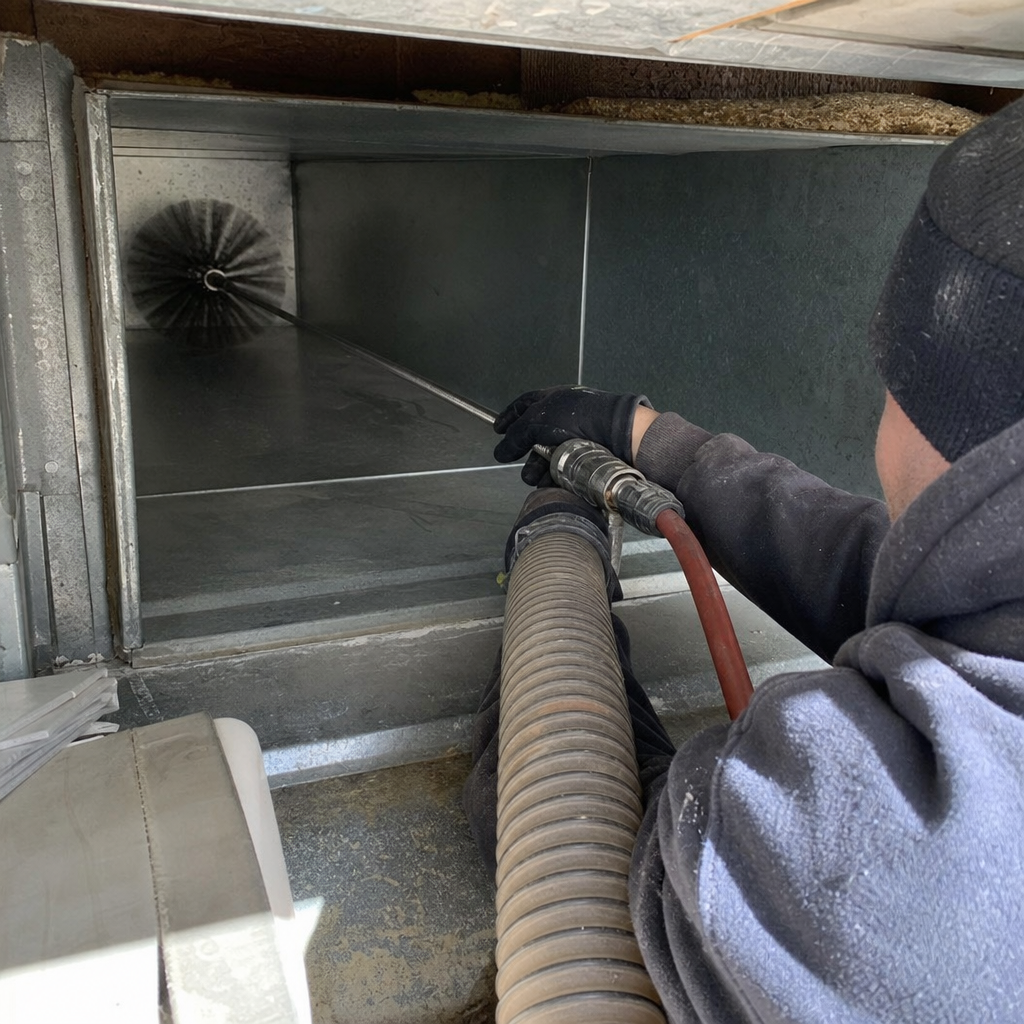
When we perform air duct cleaning in Buffalo during this window, we’re not just removing debris — we’re disrupting the colonization cycle before summer AC spreads spores room-to-room. Our Rotobrush system with HEPA containment is specifically configured for post-winter biological loads, not just dust removal.
July-August: What AC Season Reveals About Your Ducts
Air conditioning operates under negative pressure differentials that heating doesn’t, and in Buffalo’s summer humidity, this stress-tests your duct system differently than winter.
Condensation at supply registers is a diagnostic signal, not just an annoyance. When you see moisture beading on or around supply vents during July humidity, it typically indicates one of three duct problems: excessive duct leakage pulling humid attic or wall cavity air across the cold register surface; undersized or restricted return pathways causing excessive velocity and pressure drop; or missing interior duct insulation creating thermal bridging. Each of these problems wastes energy and risks water damage to ceilings and walls.
In our work across Buffalo’s suburbs — Amherst, Cheektowaga, West Seneca — we’ve noticed that homes with attic ductwork (common in 1960s-1980s construction) show leakage patterns in summer that remain invisible in winter. Heated air leaking into a cold attic in January creates minimal condensation risk. Cooled air leaking into a 130°F attic in July creates immediate condensation and accelerated duct degradation.
Summer-specific inspection points:
- Check ceiling stains near supply registers after 72+ hours of continuous AC operation
- Feel for temperature variation between rooms — more than 3°F difference indicates duct imbalance or leakage
- Listen for whistling at registers, which indicates high velocity from restricted returns or duct leakage upstream
- Monitor your condensate drain — a clogged drain in Buffalo’s humidity can back up and introduce moisture into return plenums
The equipment distinction matters here. Our Nikro and Abatement Technologies systems include pressure-testing capability that most rental-grade or franchise operations don’t carry. When Charles handles every job personally, we’re testing static pressure and identifying leaks that cleaning alone won’t address. HVAC cleaning in Buffalo should include this diagnostic layer, not just debris removal.
May & September: Managing Humidity Without HVAC Running
Buffalo has two extended shoulder seasons — roughly mid-May through mid-June, and mid-September through mid-October — when outdoor temperatures don’t justify heating or cooling, but indoor humidity remains elevated. These are the most neglected windows in home duct maintenance, and they’re when we see the most preventable damage.
Without HVAC circulation, air stratifies and humidity concentrates in ductwork. In Buffalo’s older homes with limited exterior wall insulation, this creates microclimates inside ducts: warm, humid air enters cool ductwork through leakage points, condenses, and creates intermittent wetting cycles that support bacterial and fungal growth without ever triggering homeowner awareness.
September is particularly critical. After a summer of AC operation, your duct interior has a moisture film and accumulated organic loading. Shutting the system off for 4-6 weeks allows colonization. Then October heating season starts, and you circulate those spores through every room.
What we recommend for Buffalo shoulder seasons:
- Run your HVAC fan on “circulate” mode for 15 minutes twice daily during shoulder periods — this prevents stagnation without energy-intensive conditioning
- Monitor basement humidity with a digital hygrometer; maintain below 60% RH to suppress biological activity
- Consider a whole-home dehumidifier integrated with your Honeywell or Aprilaire control system — we size and configure these for Buffalo’s specific load profiles
- Schedule duct inspection in early September, before heating season locks in any summer contamination
Your air quality, start to finish — that’s the scope we bring. Duct sealing, sanitizing, and humidity control integration aren’t afterthoughts; they’re how you prevent the cycle from repeating.
A Real Buffalo Annual Maintenance Timeline
The generic “clean your ducts every 3-5 years” advice fails Buffalo homeowners because it ignores our climate’s thermal stress on duct materials and our extended heating season’s particulate loading. Here’s what we actually implement based on 8 years of Buffalo-specific data:
| Timing | Action | Why Buffalo-Specific |
|---|---|---|
| Early October | Pre-heating inspection: heat exchanger, boot seals, filter cabinet integrity, combustion analysis | 6-month heating season ahead; any leakage point becomes a 180-day contamination vector |
| January (mid-season) | Filter change; register vacuuming; visual check for new stains or moisture at boots | Peak particulate loading; catch filter bypass before it deposits in ductwork |
| Late March–Early April | Post-heating assessment; humidity baseline reading; register discoloration check | Snowmelt humidity spike meets 5 months of accumulated organic loading |
| May | Professional duct cleaning if 2+ years since last service; biological testing if musty odors present | Highest mold activation risk; cleaning now prevents summer AC distribution |
| Early July | AC startup inspection: static pressure test, register condensation check, condensate drain verification | Negative pressure reveals leaks heating season masks; humidity load peaks |
| Early September | Pre-shutdown sanitizing; humidity control assessment; filter change | Prevent summer contamination from colonizing during shoulder season stagnation |
For most Buffalo homes with standard occupancy (2-4 residents, no pets) and standard filtration, this translates to professional duct cleaning every 2-3 years — more frequently with pets, recent renovation, respiratory sensitivities, or homes near major traffic corridors like the 33 or 198 where exterior particulate loading is higher. See our Air Duct Cleaning Permits, Codes & Inspections in NY: What You Need to Know for regulatory requirements.
160 homeowners rated us 4.9 stars, and the feedback pattern is consistent: homeowners who follow this timeline don’t call us with emergencies. They call for maintenance before problems become urgent.
Professional-Grade Equipment vs. What Homeowners Can Check
We’re direct about what homeowners can safely inspect and what requires professional equipment. This isn’t about gatekeeping — it’s about not damaging your system or missing problems that matter.
Homeowner-appropriate checks:
- Register removal and vacuuming of visible debris
- Filter condition and fit verification
- Basement trunk line visual inspection for obvious gaps or disconnected sections
- Humidity monitoring with consumer-grade hygrometers
- Basic airflow balancing (partially closing upstairs registers in summer, downstairs in winter)
What requires professional-grade equipment:
Our Rotobrush system with camera verification scrubs duct interiors while maintaining negative pressure containment — critical in Buffalo’s older homes with asbestos-containing duct tape or vermiculite insulation nearby. The Nikro portable HEPA collection system we deploy captures particles to 0.3 microns; standard shop vacuums recirculate fine particulate through their exhaust. Abatement Technologies air scrubbers maintain workspace containment during duct repair and sealing operations.
More importantly, our equipment includes diagnostic capability: static pressure manometers, airflow hoods, and thermal imaging that reveal leakage points invisible to visual inspection. In a 1920s Buffalo duplex we serviced last winter, thermal imaging revealed a 4-foot disconnected return duct in a wall cavity that the homeowner had lived with for 12 years — their “always cold bedroom” mystery solved in 10 minutes.
Professional-grade equipment, not rental-grade tools. Charles handles every job personally, and the difference is in what we find, not just what we clean.
Common Mistakes to Avoid
- Waiting for visible dust at registers. By the time you see debris at supply vents, your system has already circulated it through every room for months. Buffalo’s extended heating season accelerates this loading.
- Using duct tape for repairs. The name is misleading — duct tape fails within months in Buffalo’s humidity cycles. We seal with UL-181 rated mastic or foil tape, properly applied to clean, dry surfaces.
- Ignoring the dryer vent. Buffalo’s winter laundry loads peak, and lint accumulation is a genuine fire hazard. Dryer vent cleaning in Buffalo should be annual, not “when clothes take longer to dry.”
- Cleaning without pressure-testing. Cleaning dirty ducts without identifying why they got dirty is incomplete service. We static-test before and after to verify improvement.
- Scheduling fall cleaning after heating starts. The optimal October window closes fast. We’ve seen Buffalo homeowners wait until November, then discover their system has been circulating mold since April.
- Assuming new homes are clean. Construction debris in new Buffalo subdivisions — drywall dust, insulation fragments, sawdust — often exceeds 20-year accumulation in older homes. Pre-occupancy cleaning is essential.
When to Call a Professional
Call when you notice persistent musty odors, visible mold at registers, uneven heating or cooling between rooms, or unexplained increases in allergy symptoms among household members. After any water event — roof leak, foundation seepage, plumbing failure — duct inspection is warranted even if ducts weren’t directly wet, because humidity redistribution affects the entire system.
Pre-purchase and post-renovation are also critical timing. We’ve found construction debris, pest infestation, and previous owner neglect in Buffalo home purchases that inspections missed entirely.
Pinnacle Air Duct Cleaning Service Greater Buffalo offers free estimates in Buffalo — call (855) 763-9868. Charles handles every job personally, and we’ll tell you honestly if your system doesn’t need service yet. 8 years, one focus: your indoor air quality.
Frequently Asked Questions
Every 2-3 years for standard Buffalo homes, more frequently with pets, recent renovation, or respiratory sensitivities. Buffalo’s extended heating season and lake-effect humidity create higher particulate and moisture loading than drier climates, making the generic “3-5 year” recommendation inadequate for local conditions. Call (855) 763-9868 for a free assessment of your specific situation.
The odor typically indicates biological growth that activated during Buffalo’s humid spring and summer, then went dormant as heating season dried the system. October’s first sustained heating circulates those spores and volatile organic compounds. It’s not “just dust” — it’s a signal to inspect before continuous operation locks in exposure. We recommend September inspection to catch this preemptively.
Spring (April-May) is optimal for addressing biological concerns; fall (September-October) is optimal for pre-heating verification. If you can only schedule once, choose spring — disrupting mold colonization before summer AC distribution prevents the musty October startup problem entirely. Many of our Buffalo clients schedule both for complete coverage.
You can clean visible register surfaces and the first few feet of duct interior, but you cannot safely reach trunk lines, verify heat exchanger integrity, or maintain proper containment. More critically, you cannot pressure-test to identify why ducts became dirty. Our professional-grade Rotobrush and Nikro systems with HEPA containment protect both your system and your home’s air quality during the process.
Duct leakage is the most common hidden cause. In Buffalo’s climate, leaky return ducts pull unconditioned basement or attic air into your system, forcing longer run times. Leaky supply ducts waste conditioned air into unused spaces. We’ve measured 20-30% efficiency recovery from proper duct sealing in pre-1980 Buffalo homes — often paying for inspection and repair within two heating seasons.
It helps when allergen reservoirs in ductwork are the primary source, which we verify through inspection. In Buffalo, where extended indoor seasons concentrate exposure, reducing duct-borne particulate — pollen, pet dander, dust mite fragments, mold spores — can meaningfully reduce symptom load for sensitive individuals. We integrate with Honeywell and Aprilaire filtration systems for layered protection, not single-point solutions.
The Bottom Line
Buffalo’s climate demands a seasonally-timed approach to duct maintenance, not arbitrary calendar intervals. The critical insight: your duct system is under continuous thermal and humidity stress, and the problems that develop in one season often don’t become apparent until the next. October pre-heating verification, April-May biological disruption, July AC diagnostic testing, and September pre-shutdown sanitizing create a protective rhythm matched to local conditions. Professional-grade equipment and owner-led execution — Charles handles every job personally — ensures you’re not just cleaning debris, but identifying and preventing the root causes that degrade Buffalo home air quality. For additional guidance, explore our more guides & resources on indoor air quality.
Ready to schedule your seasonal inspection or duct cleaning? Call Pinnacle Air Duct Cleaning Service Greater Buffalo at (855) 763-9868 for a free estimate. We’ll assess your system’s current condition and recommend timing based on where you are in Buffalo’s climate calendar — not a generic template.
Written by Charles Rodriguez, Owner & Lead Technician at Pinnacle Air Duct Cleaning Service Greater Buffalo, serving Buffalo since 2018.