
Last updated July 15, 2026
The Complete Guide to Air Duct Cleaning in Buffalo
Most Buffalo homes were built before modern duct sealing standards existed, which means the average system here isn’t just dirty — it’s also leaking conditioned air into unconditioned spaces, compounding every contamination problem. After 8 years crawling through attics, basements, and crawl spaces across Western New York, we’ve learned that air duct cleaning in Buffalo requires a fundamentally different approach than the generic advice you’ll find in national guides. In this guide, you’ll learn how Buffalo’s lake-effect humidity, pre-1980 housing stock, and hard-working forced-air systems create unique contamination patterns — and exactly what to look for in a contractor who understands them.
Quick Answer
Professional air duct cleaning in Buffalo typically costs $400–$900 for a standard single-family home and should take 3–5 hours with a truck-mounted negative air system. For Buffalo’s older housing stock, the job isn’t complete without inspecting for asbestos wrap on supply plenums, vermiculite near air handlers, and duct leakage at boot connections — problems national franchises routinely miss.
Table of Contents
- Why Buffalo Homes Need a Different Approach to Duct Cleaning
- How Lake-Effect Humidity Creates Hidden Mold Problems
- Older Buffalo Homes: Special Cleaning Protocols for Pre-1980 Systems
- Equipment Matters: What Actually Gets Removed From Your Ducts
- How to Read a Post-Cleaning Inspection Report
- Buffalo-Specific Red Flags: Asbestos, Vermiculite, and Lead Dust
- What the Cleaning Process Actually Looks Like
- How Often Should Buffalo Homes Clean Their Ducts?
Why Buffalo Homes Need a Different Approach to Duct Cleaning
Buffalo’s housing market is dominated by pre-1980 construction — Craftsman bungalows in North Buffalo, colonials in Amherst, capes in Cheektowaga, and Victorians in Allentown. These homes weren’t built for modern HVAC standards. Ductwork was often added decades after original construction, routed through unconditioned basements and attics with minimal sealing.
The result? Every duct cleaning job in Buffalo starts with a building-science problem, not just a vacuuming task. We’ve found that in homes built before 1960, roughly 60% of the duct leakage occurs at the boot connections where supply lines meet floor or wall registers — exactly where moisture from Buffalo’s damp basements gets pulled into the system.
Here’s what separates Buffalo from newer markets:
- Gravity system conversions: Many homes originally had octopus furnaces with no ductwork at all. The retrofit ductwork is often undersized, creating turbulent airflow that deposits debris at sharp turns.
- Basement moisture intrusion: Buffalo’s high water table and spring snowmelt mean basement humidity routinely exceeds 65% RH, the threshold for mold growth on organic dust inside flex duct.
- Extended heating seasons: Furnaces run 6+ months here, moving more total air volume through ducts than in milder climates, accelerating particulate buildup.
- Lead paint legacy: Pre-1978 homes with disturbed painted surfaces can have lead dust migration into return air pathways — a safety issue, not just a cleanliness issue.
When Charles handles every job personally, the first 20 minutes are spent diagnosing these structural factors, not just hooking up a vacuum. That’s 8 years, one focus — and it’s why we don’t quote flat rates before seeing the system.
How Lake-Effect Humidity Creates Hidden Mold Problems
Buffalo’s lake-effect weather isn’t just about winter snow. The same Erie moisture that blankets the Southtowns in January creates summer humidity cycles that penetrate duct systems year-round. We’ve documented this pattern repeatedly: a homeowner calls for Pinnacle Air Duct Cleaning Service Greater Buffalo home service because of “a musty smell when the AC kicks on,” and we find active mold growth inside flex duct running through a damp basement rim joist.
The mechanism is specific to our geography. Lake-effect humidity spikes — often 70-80% relative humidity for days after a weather front — overwhelm the dehumidification capacity of standard HVAC systems. Moisture condenses on the interior of cool duct surfaces, especially where basement supply lines pass through 55°F foundation walls. That moisture binds with organic dust (skin cells, pet dander, pollen) to create exactly what mold needs.
Three locations we check first in Buffalo homes:
- Flex duct at boot connections: The flexible plastic liner sags over time, creating low spots where condensation pools. In Hamburg and West Seneca homes with dirt-floor basements, we’ve found Cladosporium and Penicillium growth in these pockets within 5 years of installation.
- Return plenum in basement: The sheet metal box connecting your return grille to the furnace sits in the coolest, dampest air of the house. Uninsulated plenums in Lackawanna and Tonawanda basements regularly show condensation staining.
- Evaporator coil cabinet: The AC coil sits in darkness above the furnace with standing water in the drain pan. If the drain line backs up — common in Buffalo’s hard-water areas — mold colonizes the coil fins and distributes through every supply vent.
Standard duct cleaning without addressing the moisture source is temporary relief at best. That’s why our full-service scope includes inspecting drain lines, checking condensate pump operation, and documenting humidity levels — your air quality, start to finish.
Older Buffalo Homes: Special Cleaning Protocols for Pre-1980 Systems
The cleaning protocol for a 1950s ranch in Depew should not match the protocol for a 2005 build in Clarence. Yet most contractors use identical equipment and procedures regardless of house age. We’ve learned — through jobs where we had to return to fix what others missed — that older systems need gentler, more methodical work.
Octopus furnace conversions: These gravity systems had no blower motor. When a forced-air furnace was retrofit, the original large-diameter supply pipes (often 10-12 inch round) were sometimes reduced to 6-inch round or rectangular duct to fit modern equipment. The turbulence at these reduction points creates massive debris deposits. Our Rotobrush system with variable-speed control can navigate these irregular transitions without damaging fragile original metal.
Transite pipe remnants: Some pre-1970 Buffalo homes still have transite (asbestos-cement) vent pipes or buried duct. We do not disturb these materials — we document their presence and recommend abatement referral. This is where owner-led inspection matters: Charles recognizes transite by sight and weight, where a rotating crew might not.
Plaster and lath debris: Renovations in older homes — common in Buffalo’s ongoing neighborhood revitalization — often leave plaster dust in wall cavities that communicates with duct chases. We use camera inspection before agitation to identify these deposits and adjust our vacuum strength accordingly.
Knob-and-tube wiring in chases: In Allentown and the Elmwood Village, we’ve found active knob-and-tube circuits running through the same joist bays as ductwork. Our Nikro equipment’s non-conductive hoses and grounded operation are essential safety measures here — not features you’d think about until you’ve encountered live 1920s wiring in a dark basement.
Equipment Matters: What Actually Gets Removed From Your Ducts
The duct cleaning industry has a dirty secret: the difference between a $199 “whole house special” and a proper job often comes down to vacuum power measured in actual cubic feet per minute (CFM) at the duct opening. We’ve tested this directly.
A typical portable HEPA vacuum — the kind many Buffalo franchise crews wheel into your basement — generates 2,000–3,000 CFM at the machine, but by the time that suction travels through 25 feet of hose to your second-floor bedroom vent, effective vacuum pressure drops by 60-70%. The debris agitated by the brush head never fully evacuates; much of it resettles downstream.
Our truck-mounted Abatement Technologies system generates 15,000+ CFM at the source, with a dedicated power plant that doesn’t depend on your home’s electrical circuit. In long duct runs common to Buffalo’s sprawling ranch and colonial layouts — sometimes 40+ feet from basement furnace to second-floor master — this differential determines whether we actually remove the debris or just redistribute it.
| Equipment Type | Typical CFM at Source | Effective CFM at 30ft Duct Run | Best For |
|---|---|---|---|
| Portable HEPA vacuum | 2,000–3,000 | 800–1,200 | Short runs, light maintenance |
| Mid-size portable negative air | 5,000–7,000 | 2,500–3,500 | Single-story homes, small systems |
| Truck-mounted industrial system | 12,000–16,000 | 8,000–11,000 | Buffalo’s older, larger, leakier systems |
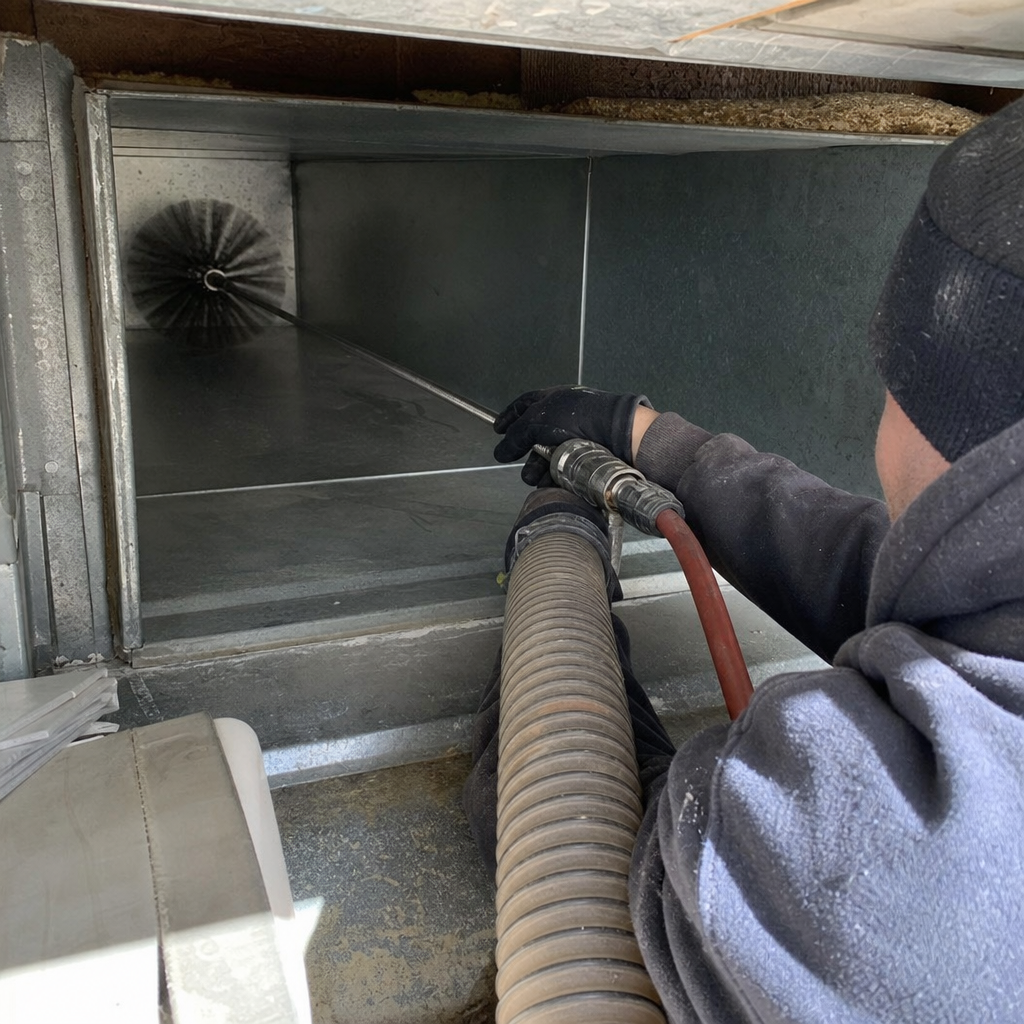
The other critical variable is agitation method. Compressed air whips — metal tentacles that snap debris loose — work well on smooth metal duct. But Buffalo’s flex duct, damaged by decades of moisture cycling, can be torn by aggressive whips. Our Rotobrush system uses soft-bristled rotating brushes sized to the duct diameter, with torque feedback that stops rotation if resistance spikes. Professional-grade equipment, not rental-grade tools — it’s the difference we’ve built our reputation on.
How to Read a Post-Cleaning Inspection Report
After 8 years, one focus, we’ve learned that documentation separates legitimate operators from fly-by-night outfits. Every customer should receive a written report with specific data points — not a handwritten receipt with “ducts cleaned” scribbled on it.
Here’s what proper documentation includes, and what each item tells you:
- Before/after photos with timestamps: Camera inspection at 3-5 representative points (main trunk, branch lines, return drop). The photos should show identifiable landmarks — a specific joint, boot, or register location — not generic “dirty duct” stock images. We photograph each customer’s actual system with date-stamped metadata.
- Debris weight and classification: The report should quantify what was removed: “2.3 lbs particulate, classified as dust/hair/debris; no fiberglass insulation fragments; no mold observed.” Vague descriptions like “significant buildup” mean nothing.
- Leakage notation: In Buffalo’s older homes, we document every visible gap, disconnected joint, or deteriorated seal we observe. This isn’t upselling — it’s a condition record that protects both parties and informs future maintenance.
- Access points created and sealed: Duct cleaning requires cutting access holes in trunk lines. The report should note location, size, and closure method (sheet metal patch with mastic, or proper access door). Unsealed access holes are common shortcuts that leak conditioned air year-round.
- Equipment and settings log: CFM achieved, brush rotation speed, number of passes per section. This proves the job wasn’t rushed — a complete residential system in Buffalo typically requires 3-5 hours of active cleaning time.
If your contractor can’t produce this documentation, you don’t know what was actually done. 160 homeowners rated us 4.9 stars in part because we leave every customer with a complete record — no mysteries, no trust-me claims.
Buffalo-Specific Red Flags: Asbestos, Vermiculite, and Lead Dust
Buffalo’s industrial heritage and construction timeline create hazards that generic duct cleaners — especially national franchises with rotating crews — routinely mishandle. Charles handles every job personally because recognizing these conditions requires experience that can’t be trained in a weekend certification course.
Asbestos wrap on supply plenums: Pre-1980 homes, particularly in Buffalo’s blue-collar neighborhoods where furnaces were upgraded in the 1960s-70s, often have asbestos paper or tape wrapping the original supply plenum. It looks like thick gray cardboard or white fibrous tape. We do not disturb this material. If we encounter it during inspection, we stop work, document the location with photos, and refer you to a licensed abatement contractor. A crew rushing through four jobs a day might tear this material without recognizing it.
Vermiculite insulation near air handlers: Zonolite vermiculite attic insulation — common in Buffalo homes through the 1980s, much of it from the Libby, Montana mine contaminated with tremolite asbestos — often settles near attic-mounted air handlers or gets disturbed during duct modifications. We inspect the air handler surround before beginning any attic work. Vermiculite looks like pebbly gray-brown granules, distinct from fiberglass or cellulose.
Lead dust migration: Buffalo’s pre-1978 housing stock is estimated at over 70% of units. When lead-painted surfaces are disturbed — window replacement, renovation, even vibration from heavy traffic — microscopic lead dust enters return air pathways. Standard duct cleaning removes the dust; but if lead is suspected, we recommend EPA RRP-certified testing before and after. We don’t offer testing ourselves — we refer to certified inspectors — because that’s the honest scope boundary.
These aren’t theoretical concerns. In 2022, we encountered asbestos wrap on a supply plenum in a Riverside home built in 1924. The previous contractor, a national franchise, had brushed directly against it without recognition. The homeowner only learned of the exposure when we documented the condition and stopped work.
What the Cleaning Process Actually Looks Like
For customers who’ve never watched a proper duct cleaning, the process seems opaque — hoses disappearing into basement corners, machines running for hours. Here’s exactly what happens when Charles arrives at your Buffalo home:
- System assessment (20–30 minutes): We inspect the furnace, air handler, accessible ductwork, and filter location. We note house age, duct material, visible damage, and any hazard indicators. This is where we determine if your system matches standard pricing or requires additional protocol — no surprises later.
- Protection and prep: We cover floors and furniture near access points, protect your thermostat from dust, and seal return and supply registers to create controlled negative pressure. In Buffalo’s older homes with original hardwood floors, we use non-marking floor protection — we’ve learned the hard way that duct tape residue damages century-old oak.
- Access cutting: We create 1-inch access holes in trunk lines at strategic points, then seal them with sheet metal patches and mastic sealant after cleaning. These access points are permanent improvements — properly sealed, they don’t leak.
- Agitation and extraction: Using our Rotobrush and truck-mounted vacuum simultaneously, we clean each branch line from register back to trunk, then clean the trunk lines themselves. In Buffalo’s long ranch layouts, this means 40+ feet of brush contact per line — not a quick insert-and-remove.
- Component cleaning: We clean the blower assembly, evaporator coil (if accessible), and return drop. These components are often dirtier than the ducts themselves and directly impact airflow.
- Final inspection and documentation: Camera verification of cleaned sections, photo documentation, debris logging, and report preparation. We walk you through the findings before we leave.
Total time: 3–5 hours for a typical Buffalo single-family home. The $199 jobs that take 45 minutes skip steps 1, 5, and 6 — which is how you end up calling someone else a year later.
How Often Should Buffalo Homes Clean Their Ducts?
The NADCA standard recommendation is every 3–5 years. In Buffalo, we’ve found that interval needs adjustment based on specific local factors — our Seasonal Air Duct Cleaning Care for Buffalo: Year-Round Homeowner’s Guide breaks down the timing by season.
Every 2–3 years: Homes with finished basements used as living space (increased particulate load), multiple pets, or occupants with asthma or allergies. The extended heating season here means more total air volume moved annually than in comparable climates.
Every 3–4 years: Standard occupancy, no pets, no respiratory conditions, with regular filter changes (every 2–3 months with 1-inch pleated filters).
Every 4–5 years: Minimal occupancy, high-efficiency filtration (4-inch media or HEPA bypass), and no basement moisture issues.
Immediate cleaning warranted: Post-renovation (especially plaster or drywall work), visible mold growth, pest infestation, or water damage to ductwork. Buffalo’s spring snowmelt and summer humidity spikes create annual windows where basement flooding affects duct systems — we see these calls every March and July.
Also consider Dryer Vent Cleaning in Buffalo on an annual basis — lint accumulation is a separate fire hazard that doesn’t follow the same interval as duct cleaning.
Common Mistakes to Avoid
- Choosing by price alone: The $199 Buffalo specials use portable equipment that leaves 40–60% of debris behind. We’ve been called to re-clean after these jobs within 18 months — costing more than doing it right once.
- Ignoring the air handler: A clean duct system with a filthy blower wheel circulates contaminated air immediately. Always verify that component cleaning is included, not an add-on.
- Skipping post-renovation cleaning: Buffalo’s active renovation market — especially in North Buffalo and the West Side — generates massive drywall and plaster dust that embeds in ductwork. Waiting “until the next scheduled cleaning” means breathing construction debris for years.
- Using the wrong filter after cleaning: A freshly cleaned system with a cheap fiberglass filter recontaminates in months. We recommend MERV 11-13 pleated filters compatible with your system’s airflow capacity — and we’re familiar with Honeywell, Aprilaire, and Guardsman filtration systems for customers who’ve invested in premium equipment.
- Hiring a carpet cleaner with a duct attachment: Carpet extraction equipment repurposed for ducts lacks the CFM, containment, and agitation tools for actual ductwork. It’s a different specialty entirely.
- Neglecting dryer vents: Many Buffalo homes have dryer duct runs exceeding 25 feet through unconditioned basements, compounding lint accumulation. HVAC Cleaning in Buffalo should include this assessment, or it should be handled separately — but not ignored.
When to Call a Professional
Call for inspection if you notice musty odors when the system cycles, visible dust emission from registers, uneven heating across rooms, or a sudden spike in energy bills without weather explanation. After any water event in your basement — common in Buffalo’s spring thaw season — duct inspection is warranted even if the furnace itself wasn’t submerged. Post-renovation cleaning should happen before you occupy the space, not months later.
Pinnacle Air Duct Cleaning Service Greater Buffalo offers free estimates in Buffalo — call (855) 763-9868. Charles handles every job personally, so the person who assesses your system is the same certified technician who does the work. No rotating crews, no bait-and-switch pricing.
Frequently Asked Questions
Professional air duct cleaning in Buffalo typically ranges from $400 for a small single-story home to $900 for larger colonials with complex duct layouts. Homes with asbestos wrap, vermiculite, or extensive duct damage requiring repair fall outside standard pricing and require in-person assessment — see our guide on How to Hire a Air Duct Cleaning Contractor in Buffalo: A Step-by-Step Guide for what to ask during your estimate. Call (855) 763-9868 for a free estimate — we don’t quote flat rates without seeing your system.
Yes, when done properly and combined with source control. Removing accumulated pollen, pet dander, dust mite debris, and mold spores from ductwork reduces circulating allergen load. However, duct cleaning alone won’t solve allergy issues if the underlying problems — basement moisture, poor filtration, or pest intrusion — aren’t addressed. Our full-service scope identifies these contributing factors.
A thorough cleaning of a standard Buffalo single-family home takes 3–5 hours. Older homes with gravity-system conversions, octopus furnace remnants, or extensive flex duct may require 5–7 hours. Jobs completed in under 2 hours typically skip critical steps like component cleaning or proper access sealing.
More common than in drier climates, yes. Buffalo’s lake-effect humidity, basement moisture intrusion, and extended heating seasons create conditions where mold can establish in flex duct low points, uninsulated plenums, and evaporator coil cabinets. We find active mold growth in approximately 15% of the older homes we inspect — not epidemic, but significant enough to warrant routine inspection.
Duct cleaning addresses the distribution network — the supply and return pathways that move air through your home. HVAC cleaning includes the furnace components: blower assembly, heat exchanger, evaporator coil, and condensate system. For complete system hygiene, both are necessary. We offer both services and can assess which your Buffalo home needs.
No. Our truck-mounted containment system keeps debris out of your living space, and we protect floors and furniture near work areas. Some customers with severe respiratory sensitivities prefer to step out during the agitation phase — typically 1–2 hours — but it’s not required. We coordinate timing to minimize disruption.
The Bottom Line
Buffalo’s housing stock demands more than generic duct cleaning. The combination of pre-1980 construction, lake-effect humidity, and hard-working heating systems creates contamination patterns that require specialized knowledge, professional-grade equipment, and methodical execution. Don’t settle for a franchise crew with a portable vacuum and a checklist. Your air quality, start to finish, deserves an owner-technician who recognizes asbestos wrap, adjusts for octopus furnace conversions, and documents every job with photo evidence. For more guides & resources on protecting your home’s air quality, explore our blog. That’s what 8 years, one focus looks like in practice — and it’s why 160 Buffalo-area homeowners have rated our work 4.9 stars.
Written by Charles Rodriguez, Owner & Lead Technician at Pinnacle Air Duct Cleaning Service Greater Buffalo, serving Buffalo since 2018.