
How Often Should You Clean Your Air Ducts in Buffalo? Every 2–3 Years for Most Homes, Sooner for First Cleanings
For homes in Buffalo, we recommend cleaning air ducts every 2–3 years after the initial deep cleaning—not the generic 3–5 year interval you’ll see online, which raises the question Is Air Duct Cleaning Worth It? (Buffalo, NY). That standard was written for moderate climates where furnaces run maybe half the year. Buffalo’s heating season stretches from October through April or May, with lake-effect humidity compounding the debris load. If your system has never been cleaned, or your home was built before 1950 with retrofitted ductwork, the first cleaning should happen now regardless of calendar time. Call us at (855) 763-9868 for a free assessment.
Why Buffalo’s Furnace Runtime Demands a Shorter Interval
The “every 3–5 years” advice assumes roughly 2,000 annual blower hours. In Buffalo, most residential furnaces push well past 3,000 hours—some years closer to 4,000 with persistent lake-effect cold snaps and cloud cover that inland cities at our latitude simply don’t experience. Your ducts aren’t just sitting there; they’re a conveyor belt for whatever’s settled in your home.
Here’s how the math breaks down for a typical Buffalo home:
| Climate Type | Annual Heating Hours | Debris Accumulation in 3 Years | Recommended Interval |
|---|---|---|---|
| Moderate (national average) | 1,800–2,400 hrs | 5,400–7,200 hrs equivalent | 3–5 years |
| Buffalo lake-effect zone | 3,000–4,200 hrs | 9,000–12,600 hrs equivalent | 2–3 years |
| Buffalo + pre-1950 retrofit ducts | 3,000–4,200 hrs | 12,000–16,000+ hrs equivalent* | 2 years, inspect annually |
*Higher accumulation due to excessive joints, dead-end runs, and turbulence in retrofitted systems common in Allentown, South Buffalo, Black Rock, and Riverside.
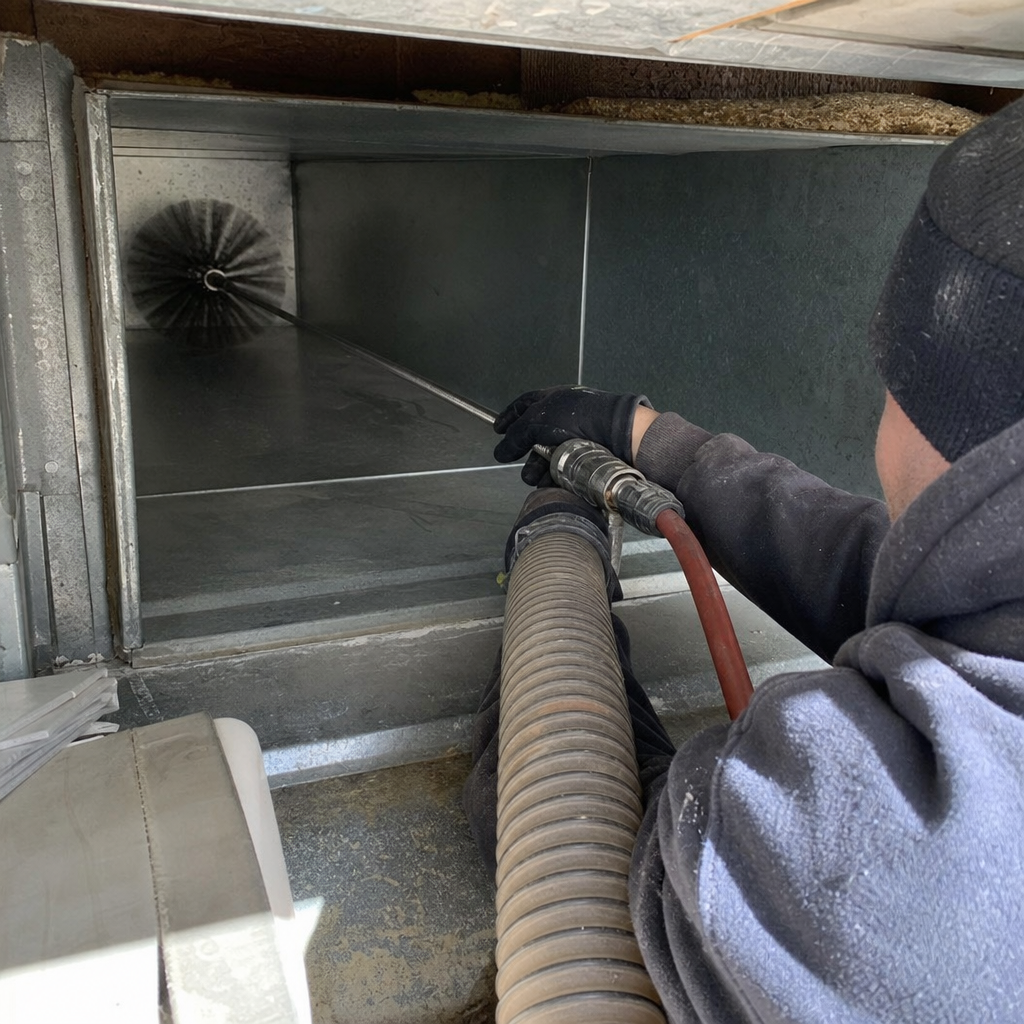
We use Rotobrush and Abatement Technologies systems specifically because Buffalo’s older duct configurations—narrow runs, sharp turns, horizontal sections—defeat standard equipment. Charles handles every job personally, and he’s crawled through enough of these retrofitted systems to know where the debris hides.
The Triggers That Should Override Any Calendar Schedule
Calendar years are a starting point, not a rule. These conditions should prompt an immediate inspection regardless of when you last cleaned:
- Home renovation completed: Drywall dust, sawdust, and fiberglass particles bypass standard filters and coat duct interiors. We’ve opened systems in North Buffalo homes six months post-renovation that looked like they’d sat for a decade.
- New occupant with asthma, allergies, or COPD: The particulate load your family tolerated becomes a medical issue for someone with compromised airways.
- Visible debris at registers: If you can see it at the vent, the trunk lines are worse. That’s not surface dust; it’s what’s made it through the entire run.
- Condensation or musty odor from vents: Lake Erie’s winter humidity sustains moisture inside under-insulated ductwork. Mold colonization follows. This isn’t hypothetical—we’ve found active growth in Riverside and Black Rock homes where homeowners assumed “it’s just old house smell.”
- Purchase of a previously owned home with unknown maintenance history: We’ve pulled construction debris from the 1970s out of ducts in Parkside and Elmwood Village. The previous owner didn’t clean; you inherit it.
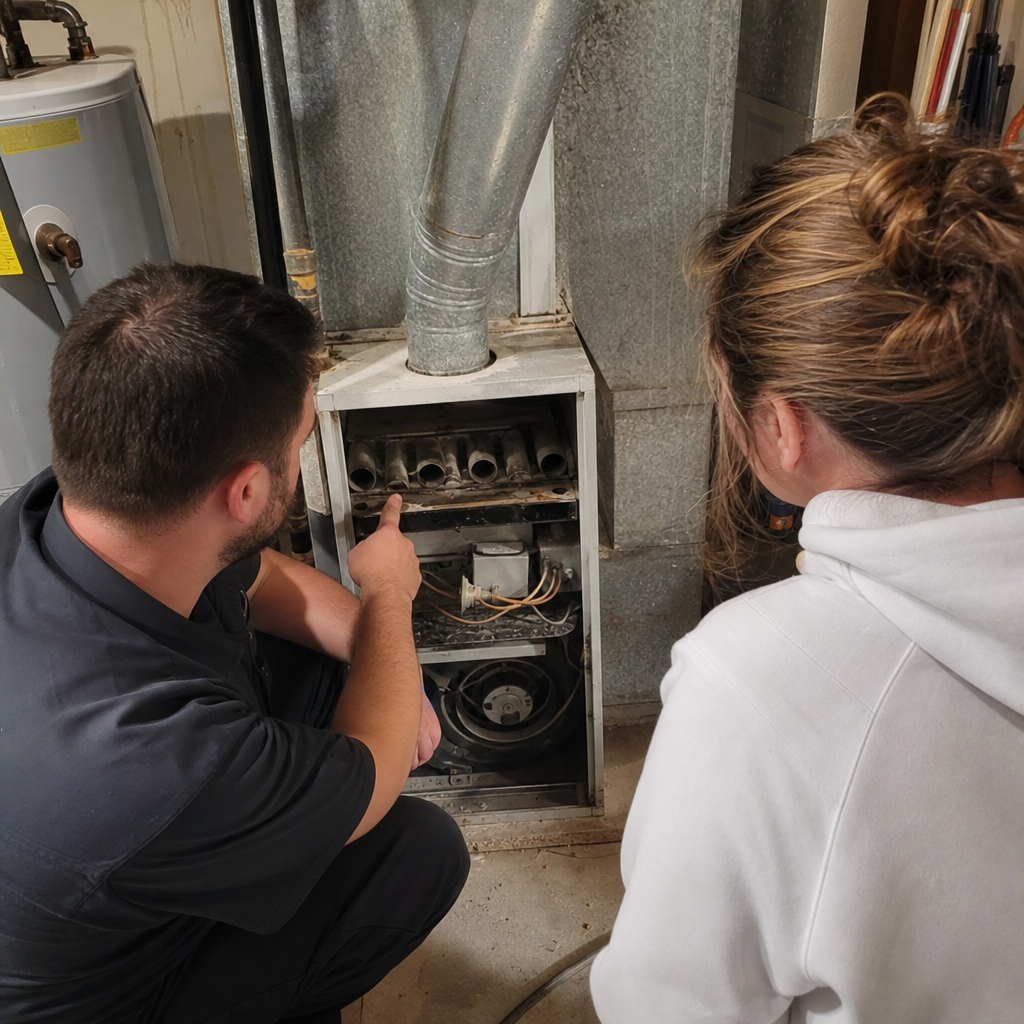
Our Air Duct Cleaning process includes a pre-job camera inspection so we can show you exactly what you’re dealing with before any work begins.
Why Buffalo’s Housing Stock Makes This More Urgent
Buffalo’s housing market is dominated by pre-1950 construction—Victorians, Colonial Revivals, and working-class doubles in neighborhoods like Allentown, South Buffalo, Black Rock, and Riverside. These homes were built for coal-fired boilers and steam radiators. Forced-air duct systems were retrofitted decades later, often in the 1960s and 70s, by contractors working around finished walls, cast-iron radiator pipes, and bricked-up coal chutes.
The result? Ductwork with characteristics that accelerate accumulation:
Excessive joints and seams. Every connection is a turbulence point where particles drop out of airflow instead of carrying through to registers. Modern duct systems minimize joints; retrofitted Buffalo systems have dozens in a single run.
Horizontal dead-end sections. Ducts routed through crawl spaces and closets often level out in sections with no airflow velocity to move debris. We’ve found registers in South Buffalo homes that haven’t flowed meaningful air in twenty years—just gradual sediment buildup.
Hand-cut openings and irregular dimensions. Standard cleaning equipment assumes round or rectangular ductwork in predictable sizes. We’ve encountered ducts squeezed between floor joists with 4-inch vertical clearance, or routed through former coal chutes with 90-degree turns that require Nikro flexible systems to navigate at all.
Charles grew up in Black Rock, a few blocks from the Niagara River, and got his foundation in HVAC systems at Erie Community College’s North Campus in Williamsville. An instructor there told him ductwork is where most contractors cut corners—that observation has guided eight years of hands-on work across Western New York. When he inspects a pre-war Buffalo home, he knows what to expect before he opens the first register.
Lake-Effect Humidity: The Hidden Accelerator
Buffalo’s proximity to Lake Erie creates a moisture profile that inland markets don’t replicate. Even in January, ambient humidity sustains condensation inside ductwork that lacks adequate insulation—common in older homes where retrofit ducts were never properly wrapped.
This matters for cleaning intervals because:
Wet debris adheres; dry debris flows. Dust that would otherwise circulate and filter out instead cakes onto duct walls, creating a substrate for mold spores. We’ve inspected ducts in Riverside where a thin layer of gray dust had become a thick, matted carpet with visible fungal growth at the seams.
Mold changes the calculus from maintenance to remediation. A standard cleaning every 2–3 years assumes particulate accumulation. Once mold colonizes, you’re looking at sanitizing treatment, possible duct replacement in affected sections, and more frequent follow-up inspections. Catching it early—through visual inspection during routine cleaning—resets the interval intelligently rather than waiting for odor or health symptoms to force the issue.
Rochester, by comparison, draws lake effect from Ontario under different moisture dynamics. Buffalo’s specific pairing of extreme heating-season length and Erie-sourced humidity is genuinely distinctive, and it should inform how you schedule maintenance.
What We See After 8 Years in Buffalo Duct Systems
I’ve been in a lot of duct systems in this city. I’ll tell you exactly what’s in yours.
After 160 verified reviews and eight years of focused indoor air quality work, Charles’s honest assessment: the first cleaning interval matters more than any subsequent schedule. We’ve opened 20-year-old systems in Black Rock and Allentown that contained layers of debris—construction dust, pet dander, skin cells, insulation fragments—compacted to half-inch thickness. Homeowners who’d “meant to get around to it” were shocked by what we pulled out.
Once that baseline is established, every 2–3 years is defensible for most Buffalo homes. But the “first one” can’t wait for a convenient calendar mark. If you don’t know when your ducts were last cleaned, or you know they never have been, that uncertainty is itself the trigger.
Our equipment lineup—Rotobrush, Nikro, and Abatement Technologies—is the same professional-grade inventory used by commercial IAQ contractors, not rental-grade tools from a hardware store. Charles handles every job personally as Lead Technician. Your air quality, start to finish, under one provider who knows Buffalo’s housing stock from the inside out.
Key Takeaways for Buffalo Homeowners
- Baseline interval: 2–3 years after initial cleaning, not the generic 3–5 year recommendation
- First cleaning: Don’t delay—unknown history in pre-1950 housing stock means unknown accumulation
- Climate adjustment: 3,000+ annual blower hours in Buffalo equal 5–6 years of moderate-climate runtime in 3 calendar years
- Immediate triggers: Renovation, new respiratory-sensitive occupant, visible debris, musty odors, or home purchase
- Housing stock factor: Retrofitted ducts in older neighborhoods accumulate faster and resist standard equipment
- Moisture risk: Lake-effect humidity sustains condensation and mold potential year-round
FAQs
Most residential Affordable Air Duct Cleaning in Buffalo, NY jobs range from $350–$650 for a standard single-system home, with larger homes, multiple HVAC zones, or heavily contaminated pre-1950 systems running higher. The exact price depends on square footage, number of registers, and whether we find conditions requiring sanitizing or repair. Call (855) 763-9868 for a free, no-pressure estimate—Charles handles every assessment personally.
No—deferring cleaning in Buffalo’s climate typically increases total cost because compacted debris requires more labor, and moisture-related mold issues escalate from standard cleaning to remediation, raising your Whole House Air Duct Cleaning Cost in Buffalo, NY. We’ve serviced homes where a $400 cleaning delayed three years became an $1,100 job requiring sanitizing and partial duct sealing. The 2–3 year interval is the economical choice, not the expensive one.
Yes—our pre-job inspection uses camera equipment to show you interior conditions through existing register openings, and we check airflow at each vent with calibrated meters. In Buffalo’s older housing stock, we also assess duct configuration from accessible areas to identify problem sections. You’ll see what we see before any work begins.
Yes, particularly for occupants sensitive to dust mites, pet dander, and mold spores—all of which accumulate in ducts and recirculate during Buffalo’s extended heating season. Charles got into this work specifically after his younger son struggled with persistent allergy issues. Removing the reservoir of accumulated allergens from your duct system reduces the total load your filtration system must handle, though we recommend pairing cleaning with quality filtration compatible with your HVAC setup—we’re familiar with Honeywell, Aprilaire, and Guardsman systems for homeowners who’ve already invested there.
If you’d rather have it looked at, Pinnacle Air Duct Cleaning Service Greater Buffalo offers a no-pressure assessment in Buffalo—call (855) 763-9868 and Charles will walk you through what your specific system needs.
Written by Charles Rodriguez, Owner & Lead Technician at Pinnacle Air Duct Cleaning Service Greater Buffalo, serving Buffalo, NY.