
Last updated July 15, 2026
Air Duct Cleaning Maintenance Checklist for Buffalo Homeowners
Changing your filter every 90 days is correct advice — but it won’t catch the disconnected flex duct in your attic that’s been dumping conditioned air into insulation for two heating seasons. In Buffalo, where we run forced-air systems hard through five-month winters and deal with lake-effect pollen spikes that can coat a screen door green, duct maintenance is about spotting what your filter can’t catch. Over 8 years crawling through attics, crawlspaces, and mechanical rooms across Western New York, we’ve learned that homeowners who know the visual warning signs catch problems before they become $400 heating bills or mold remediation jobs. This checklist isn’t a cleaning schedule — it’s a diagnostic framework for what to observe, document, and act on between professional cleanings.
Quick Answer
A proper air duct maintenance checklist for Buffalo homeowners includes monthly visual inspections of registers and boots, quarterly filter changes with seasonal MERV adjustments, biannual attic/crawlspace checks for disconnected or sagging flex duct, and annual documentation of utility costs and system performance. Most importantly: know the six warning signs that indicate your duct system needs our Air Duct Cleaning services beyond what DIY maintenance can address.
Table of Contents
- Visual Inspection Points You Can Check Without Tools
- How to Use Your Utility Bills as a Duct Performance Indicator
- Seasonal Filter Strategy for Buffalo’s Climate
- Signs a Previous Cleaning Was Done Improperly
- What to Document Before and After HVAC Work
- Your Yearly Maintenance Schedule
- Common Mistakes to Avoid
- When to Call a Professional
- Frequently Asked Questions
Visual Inspection Points You Can Check Without Tools
Most Buffalo homes built between 1950 and 1990 have galvanized steel trunk lines with flexible duct extensions to second-floor rooms. That flex duct is your vulnerability — it degrades faster than hard pipe, especially in unconditioned attics that hit 140°F in July and drop below freezing in January.
Here’s what to look for during a 15-minute walkthrough, no tools required:
- Register color and condition. Remove two or three floor or ceiling registers. The metal boot behind the register should be the same color as your ductwork — typically dull gray or silver. If it’s black, brown, or has a fuzzy coating, that’s accumulated debris that your filter isn’t catching. In Buffalo’s older neighborhoods like North Park or Parkside, we often find boots that were never cleaned during previous service calls because the technician only cleaned the main trunk line.
- Register fit and seal. The register should sit flush against the boot with no visible gap. A loose register means conditioned air is leaking into your wall cavity — common after decades of seasonal expansion and contraction in Buffalo’s freeze-thaw climate.
- Visible flex duct sag. If you have attic access, look for flex duct that dips between support points. Every sag creates a low spot where moisture and debris collect. In Hamburg and West Seneca, where humidity spikes off Lake Erie, we’ve replaced flex duct that had standing water in sag points from condensation.
- Kinks and sharp bends. Flex duct should follow gentle curves. A 90-degree kink reduces airflow by up to 30% and strains your blower motor. This is especially common in attic conversions or after DIY insulation projects where someone moved ductwork and never restored proper routing.
- Duct tape condition. Ironically, duct tape fails on ducts. If you see gray fabric tape that’s peeling, brittle, or hanging loose, the seal has failed. Proper sealing requires mastic or foil-backed tape rated for HVAC use — something we apply with every air duct cleaning in Buffalo.
- Return air pathway obstruction. Your return grille should pull air freely. If you hold a tissue near it, it should cling lightly. Weak suction often means a crushed return duct in the basement or a filter that’s been sucked into the blower compartment — both require professional attention.
Document anything unusual with your phone. A photo of a blackened boot or sagging flex duct gives a technician precise information before they arrive and creates a baseline for comparison next year.
How to Use Your Utility Bills as a Duct Performance Indicator
Buffalo homeowners pay among the highest residential gas rates in New York State, and electricity isn’t cheap either. Your utility bills are a lagging indicator of duct performance — they’ll tell you something’s wrong after it’s already costing you money, but they’ll tell you definitively.
Here’s the methodology we recommend:
Establish your baseline. Collect 24 months of bills and calculate your average therms (gas) and kWh (electric) per heating degree-day. National Weather Service data for Buffalo is available online. This normalizes for weather variation — a cold January will always cost more than a mild one, but the per-degree-day cost should stay consistent.
Watch for these thresholds:
- 12-15% increase year-over-year with similar weather patterns: Likely duct leakage or blower inefficiency. In our experience, this often traces to disconnected flex duct or failed seals at trunk line connections.
- 20%+ increase: Multiple system failures or significant duct damage. We’ve found collapsed return ducts and completely separated supply runs causing this magnitude of loss.
- High electric use in winter: Your blower motor is running longer to compensate for lost airflow. This shows up as kWh spikes even when gas use looks normal.
Seasonal context matters in Buffalo. November and March are your diagnostic months — cold enough to run heat consistently, but not so cold that extreme weather distorts the data. If your March 2024 bill jumps 18% over March 2023 with similar temperatures, schedule a duct inspection — and review Air Duct Cleaning Permits, Codes & Inspections in NY: What You Need to Know — before next heating season.
We use a thermal camera and digital manometer on every job to quantify leakage, but your bill history tells us where to look first. Homeowners who bring 24 months of bills to an estimate get a more targeted assessment — and often a faster resolution.
Seasonal Filter Strategy for Buffalo’s Climate
Filter advice that works in Phoenix or Miami fails in Buffalo. Our pollen season is compressed and intense — tree pollen peaks in late April and early May, then grass pollen follows immediately. Meanwhile, our five-month heating season creates sustained particulate load from combustion byproducts, and neighborhoods with wood-burning stoves or fireplaces see additional fine particulate that standard filters won’t capture.
Here’s our season-by-season filter protocol:
| Season | MERV Rating | Change Frequency | Buffalo-Specific Rationale |
|---|---|---|---|
| March–May | MERV 11–13 | Every 30–45 days | Tree and grass pollen peaks; lake-effect wind patterns concentrate allergens |
| June–August | MERV 8–11 | Every 60 days | Lower particulate load; higher humidity means watch for filter media degradation |
| September–November | MERV 11 | Every 45 days | Ragweed and mold spores from decaying vegetation; first furnace startup stirs summer dust accumulation |
| December–February | MERV 11–13 | Every 30 days | Maximum furnace runtime; wood-burning particulate in older neighborhoods; minimal fresh air exchange |
Critical caveat: Higher MERV ratings restrict airflow. Before upgrading to MERV 13, verify your blower motor can handle the static pressure increase. Systems with variable-speed ECM motors (common in installations after 2010) adapt automatically; older PSC motors may overheat or fail prematurely. If you’re unsure, check your furnace manual or have a technician measure static pressure. We’ve replaced blower motors that failed because a homeowner installed MERV 16 filters on a 1980s furnace.
For homes with Honeywell or Aprilaire whole-house media filters — common upgrades in Buffalo’s premium HVAC market — the filter cabinet accepts thicker media (4–5 inches) that captures more particulate without the airflow restriction of a 1-inch MERV 13. We service these systems regularly and stock compatible media.
Signs a Previous Cleaning Was Done Improperly
Not all air duct cleaning in Buffalo is equal. We’ve re-cleaned systems that were “serviced” six months prior by crews using shop vacuums and compressed air wands — methods that dislodge debris without removing it, or worse, damage flex duct and dislodge connections.
Watch for these indicators that your last cleaning left problems behind:
- Re-soiled registers within 12 months. Proper cleaning with negative-air containment and mechanical agitation should leave your system clean for 2–3 years in normal conditions. If registers are dusty again in six months, the previous crew likely blew debris downstream without extraction — or missed sections entirely.
- Persistent musty odor post-cleaning. A proper cleaning removes the organic material that feeds odor. Lingering smell suggests moisture remains (from inadequate drying or an undetected leak) or that the technician used a chemical “deodorizer” that masked rather than eliminated the source. We don’t cover odors — we remove what’s causing them.
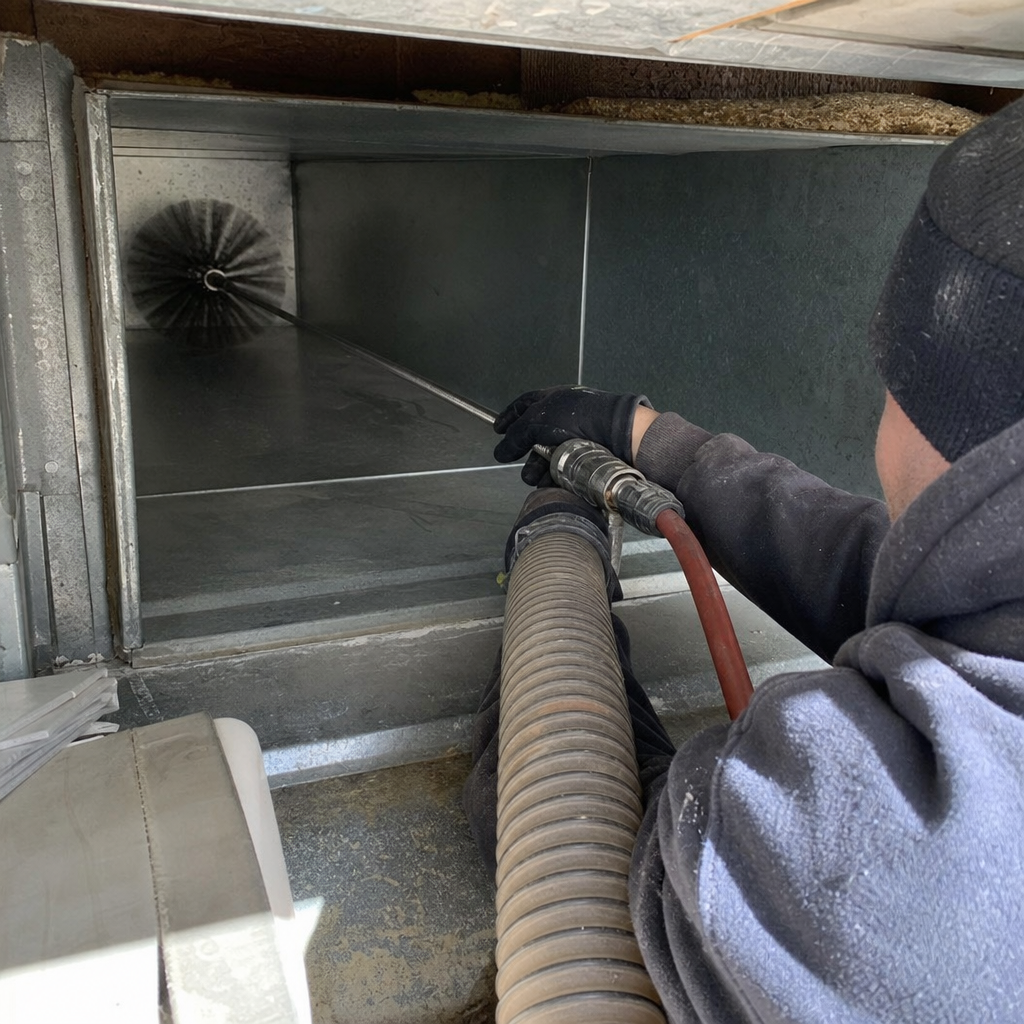
- Visible debris at register openings after first furnace cycle. This is the telltale sign of a shop-vac job. Without negative-air containment, dislodged debris settles in low-velocity areas and blows out when the system restarts. Our Rotobrush and Nikro systems maintain continuous suction during agitation, capturing debris at the source.
- New rattling or whistling sounds. Improper cleaning can dislodge dampers, damage flex duct supports, or leave access panels unsecured. We’ve found access holes cut into trunk lines and left unsealed — a code violation and an energy waste.
- No before/after documentation. A professional cleaning should include photo documentation of at least the register boots and main trunk access points. If your previous provider handed you a receipt and left, you have no verification of scope or quality.
In Buffalo’s competitive market, we’ve seen franchise operations send technicians with two weeks of training to jobs that require judgment developed over years. Charles handles every job personally — 8 years, one focus — and we document everything.
What to Document Before and After HVAC Work
Your duct system is hidden infrastructure. Without documentation, you’re guessing about changes over time — and guessing leads to unnecessary service calls or missed problems.
Here’s your documentation protocol:
Annual baseline photos (do this every October, before heating season):
- Wide shot of furnace/ air handler with filter door open, showing filter condition and fit
- Close-up of each register boot (2–3 representative locations)
- Attic flex duct routing, if accessible — show support points and any sag
- Utility bill summary page with usage data visible
Before any professional service:
- Photo the same register boots you’ll ask the technician to clean
- Note any specific odors, sounds, or performance issues with dates
- Record current filter brand, size, and installation date
After any professional service:
- Request and retain before/after photos from the provider
- Photo any access panels or modifications made to your system
- Note the technician’s name, equipment used, and scope of work
- File with your home maintenance records
This documentation becomes invaluable when selling your home — Buffalo’s disclosure requirements include HVAC system condition — and when evaluating whether a problem is new or recurring. We’ve resolved disputes with warranty companies because our photo documentation showed pre-existing conditions versus new damage.
For HVAC cleaning in Buffalo, we provide a detailed work summary with photos as standard practice. Your air quality, start to finish.
Your Yearly Maintenance Schedule
Buffalo’s climate demands a coordinated approach. Here’s the calendar we recommend to our customers:
| Month | Task | Notes |
|---|---|---|
| October | Annual documentation; pre-heating inspection; install winter-rated filter | Before first furnace cycle; check for summer pest intrusion in outdoor vents |
| November | First filter check; monitor for startup odors | New furnace smell normal for 2–3 cycles; persistent odor warrants inspection |
| January | Mid-winter filter change; compare utility usage | Coldest month — maximum system load, maximum diagnostic value |
| March | Year-over-year bill analysis; schedule spring service if needed | Optimal timing for duct cleaning before AC season |
| April | Install high-MERV pollen filter; inspect outdoor condenser clearance | Lake-effect pollen starts early — don’t wait for calendar spring |
| June | Filter change; check condensate drain | Humidity season begins; clogged drain causes mold and water damage |
| September | Final filter change; pre-winter inspection | Schedule any needed service before October rush |
This schedule assumes standard fiberglass or pleated filters. If you have a Honeywell electronic air cleaner or Aprilaire media cabinet, follow manufacturer intervals — typically 6–12 months for media, annual cleaning for electronic cells.
Don’t forget your dryer vent cleaning in Buffalo — lint accumulation is a year-round fire hazard that peaks in winter when heavy fabrics increase load. We clean dryer vents with the same professional-grade equipment, not rental-grade tools, and include exterior termination inspection to verify proper backdraft damper function.
Common Mistakes to Avoid
- Buying filters by price, not MERV and fit. A $2 filter that gaps at the sides is worse than no filter — it bypasses filtration entirely. Measure your filter slot precisely and buy for seal quality, not just rating.
- Closing vents in unused rooms. Buffalo’s older homes have fixed-speed blowers not designed for zone restriction. Closing vents increases static pressure, strains the blower, and can cause duct leakage at weak joints. Use a programmable thermostat instead.
- Ignoring bathroom and kitchen exhaust ducts. These terminate through your roof or soffit and are often the entry point for moisture, pests, and cold drafts. The ductwork itself needs periodic inspection, not just the room-side fan.
- DIY duct sealing with hardware-store tape. Standard duct tape degrades in 1–3 years in Buffalo’s temperature extremes. Proper mastic application requires surface prep and access that most homeowners can’t achieve safely. We’ve re-done more failed DIY seals than we can count.
- Assuming a new furnace means clean ducts. Replacement furnaces connect to existing ductwork. We’ve found decades of accumulated debris in homes with 2-year-old furnaces — the new equipment just blows it around more efficiently.
- Skipping maintenance after renovation. Buffalo’s older housing stock sees constant renovation. Drywall dust, sawdust, and fiberglass insulation fragments enter duct systems during construction and remain indefinitely without professional cleaning. Schedule cleaning 2–4 weeks post-renovation, after dust has settled.
- Waiting for symptoms to act. By the time you’re experiencing allergy flare-ups, visible dust, or odor, the problem is advanced. Preventive observation — the core of this checklist — catches issues at lower cost and lower health impact.
When to Call a Professional
Some conditions require equipment and expertise beyond homeowner capability. Call for professional inspection when you observe: disconnected or damaged flex duct (requires attic/crawlspace work with fall protection); moisture or mold in any duct component; pest evidence — droppings, nesting material, or insect swarms at registers; persistent odors after filter change and basic cleaning; utility cost increases exceeding 15% year-over-year with normal weather; or any system modification — new furnace, added central air, duct rerouting — that needs post-work verification.
Pinnacle Air Duct Cleaning Service Greater Buffalo offers free estimates in Buffalo and throughout Western New York. Charles handles every job personally, with 8 years of focused indoor air quality experience and professional-grade Rotobrush, Nikro, and Abatement Technologies equipment. Call (855) 763-9868 to schedule — we’ll review your documentation, inspect your system, and give you a clear assessment of what maintenance can address versus what requires professional intervention.
Frequently Asked Questions
Every 3–5 years for typical residential systems, or sooner if you have pets, allergies, recent renovation, or observe the warning signs in this checklist. Buffalo’s extended heating season and older housing stock often push toward the shorter end of that range — we’ve found 3–4 years is typical for homes built before 1980 with original ductwork.
You can maintain registers, change filters, and observe conditions, but thorough duct cleaning requires negative-air containment, mechanical agitation, and access tools that aren’t available to homeowners. More importantly, disturbing accumulated debris without proper extraction can worsen indoor air quality temporarily. For the full scope of what’s involved, see our Pinnacle Air Duct Cleaning Service Greater Buffalo home page.
Rapid re-soiling usually indicates the cleaning missed sections, used inadequate extraction, or there’s an ongoing source like duct leakage pulling attic or crawlspace debris into the system. In Buffalo, we also see this when return ductwork runs through unfinished basements and pulls concrete dust or fiberglass insulation fragments. A proper inspection identifies the source — surface cleaning won’t fix it.
MERV 11–13 pleated filters during April–June, changed every 30–45 days. For homes with Honeywell or Aprilaire media cabinets, the 4–5 inch pleated media achieves similar capture with less airflow restriction. Avoid washable electrostatic filters — they degrade quickly in high-load conditions and rarely achieve their rated MERV in practice.
Request before/after photos of register boots and main trunk access points. Within 48 hours of proper cleaning, you should notice reduced dust accumulation on surfaces, no debris blow-out at registers when the system cycles, and no chemical or musty odors. If any of these are present, the cleaning was incomplete or improper — something we assess regularly when homeowners call us for second opinions.
Cleaning alone has modest direct impact on efficiency — 5–10% improvement in typical cases. The larger savings come from identifying and sealing leaks, reconnecting separated ductwork, and ensuring proper insulation that a thorough inspection reveals. We address the full system, not just debris removal, which is why our customers see sustained utility improvements.
The Bottom Line
Effective duct maintenance in Buffalo isn’t about following a generic schedule — it’s about trained observation of your specific system under our specific climate stressors. Know your registers, know your bills, document everything, and understand which warning signs demand professional attention. The homeowners who avoid emergency calls and unexpected costs are the ones who treat their ductwork as critical infrastructure worth monitoring, not hidden infrastructure worth ignoring. For more guides & resources, visit our blog. With 160 homeowners rating us 4.9 stars, we’ve built our reputation on helping Buffalo residents make informed decisions about their indoor air quality.
Ready for a professional assessment? Call (855) 763-9868 for a free estimate. Charles will handle your inspection personally, review any documentation you’ve gathered, and give you a clear, specific recommendation — no pressure, no upselling, just the same honest expertise we’ve delivered across 8 years in Western New York.
Written by Charles Rodriguez, Owner & Lead Technician at Pinnacle Air Duct Cleaning Service Greater Buffalo, serving Buffalo since 2018.