
Air Duct Sanitizing Service in Buffalo, NY: What It Actually Does and When You Need It
Air duct sanitizing service in Buffalo typically runs $275–$495 when performed after a full duct cleaning, and it’s specifically designed to address mold colonization risk inside your ductwork—not to cover up odors or replace proper mechanical cleaning. At Pinnacle Air Duct Cleaning Service Greater Buffalo, we apply our Air Quality & Sanitizing services using EPA-registered antimicrobial agents and Abatement Technologies equipment, but only after we’ve physically removed the dust load that would otherwise block the treatment from reaching the surfaces that matter. If you’re concerned about musty smells when your furnace kicks on, or you’ve had water intrusion near your duct runs, call us at (855) 763-9868 and we’ll tell you straight whether sanitizing makes sense for your system.
Buffalo sits on Lake Erie. The lake doesn’t freeze completely, which means ambient humidity stays elevated even in January. Older ductwork that runs through uninsulated spaces is a condensation surface for most of the heating season—and condensation plus dust equals mold. We’ve crawled through enough systems in Allentown, Black Rock, and Riverside to know this isn’t a theoretical problem. It’s a predictable outcome of Buffalo’s specific combination of lake-sourced moisture, extended heating season, and housing stock that was never designed for forced-air ductwork in the first place.
Why Buffalo’s Climate Creates a Unique Mold Risk Inside Ductwork
Most homeowners assume winter air is dry. In Buffalo, that’s only half true.
Our furnaces run nearly continuously from October through April—six-plus months of blower operation driven by lake-effect cloud cover and snowfall that keeps temperatures suppressed far longer than inland cities at our latitude. That extended runtime loads duct interiors with dust, skin cells, and allergens at an accelerated annual rate. Meanwhile, Lake Erie’s open water sustains humidity levels that drier continental climates at the same latitude simply don’t experience.
Here’s where the physics get specific to Buffalo homes: when warm, humid indoor air contacts the cold metal of ductwork running through uninsulated exterior walls, crawl spaces, or attics, the surface temperature drops below the dew point. Condensation forms on the interior duct walls. That moisture binds with the dust layer already accumulated from six months of continuous blower operation. Mold spores—ubiquitous in Western New York’s environment—find food, water, and a stable temperature in one location.
We’ve seen this pattern repeatedly in pre-1950 homes throughout Buffalo’s older neighborhoods, where retrofit ductwork was shoehorned through finished walls and crawl spaces never designed for it. The narrow, irregular runs with excessive joints create dead-end sections where particulate accumulates faster and standard equipment struggles to reach. In Black Rock, where Charles Rodriguez grew up a few blocks from the Niagara River, we’ve found duct sections routed around cast-iron radiator pipes and through bricked-up coal-chute spaces that haven’t been professionally cleaned in decades—if ever.
This specific pairing—extreme heating-season length plus lake-sourced moisture—isn’t replicated in neighboring markets. Rochester draws lake effect from Ontario under different moisture dynamics. Cleveland, similarly situated on Erie, has a shorter continuous heating season. Buffalo’s duct systems face a stress profile that’s genuinely distinctive, and sanitizing without acknowledging that context is just spraying chemicals into a dark box.
What Air Duct Sanitizing Actually Is (and What It Isn’t)
There’s a meaningful distinction that gets lost in most marketing: fogging a scented sanitizer through your vents is not the same as applying an EPA-registered antimicrobial agent with professional IAQ equipment after mechanical cleaning has removed the obstructing debris load.
The fogging approach—sometimes sold by franchise crews as a “fresh scent” treatment—deposits a surface mist that doesn’t penetrate the biofilm layer where mold colonies establish themselves. It’s essentially masking odor. The antimicrobial application we perform with our Abatement Technologies systems requires direct surface contact to be effective, which is why we won’t offer sanitizing as a standalone service. We’ve been in a lot of duct systems in this city. I’ll tell you exactly what’s in yours—and if there’s three-quarters of an inch of compacted dust between our treatment and the metal, we’re not going to charge you for a procedure that can’t work.
The correct sequence matters:
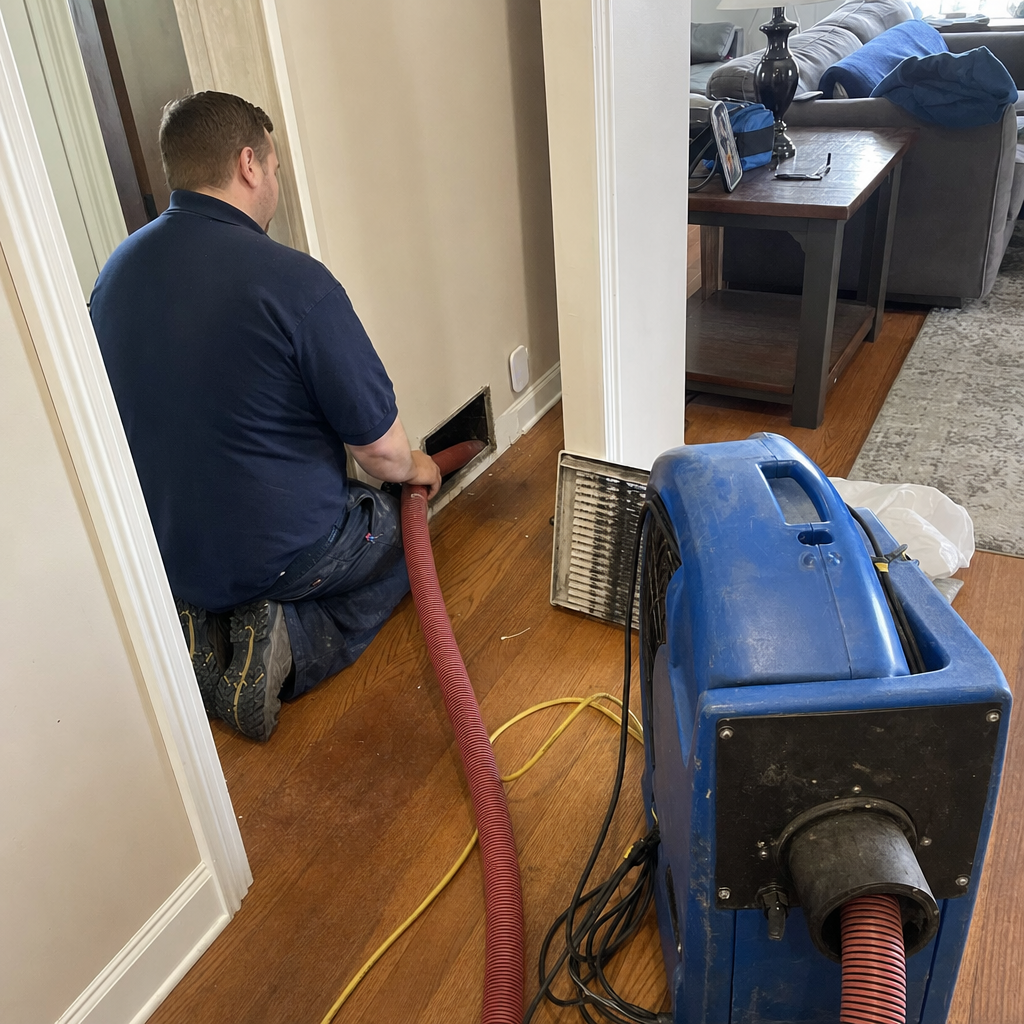
- Mechanical cleaning first: Rotobrush and Nikro agitation and extraction systems remove the particulate load that would otherwise shield mold colonies from treatment
- Visual verification: We inspect the cleaned surfaces—Charles handles every job personally, so this isn’t delegated to a trainee with a flashlight app
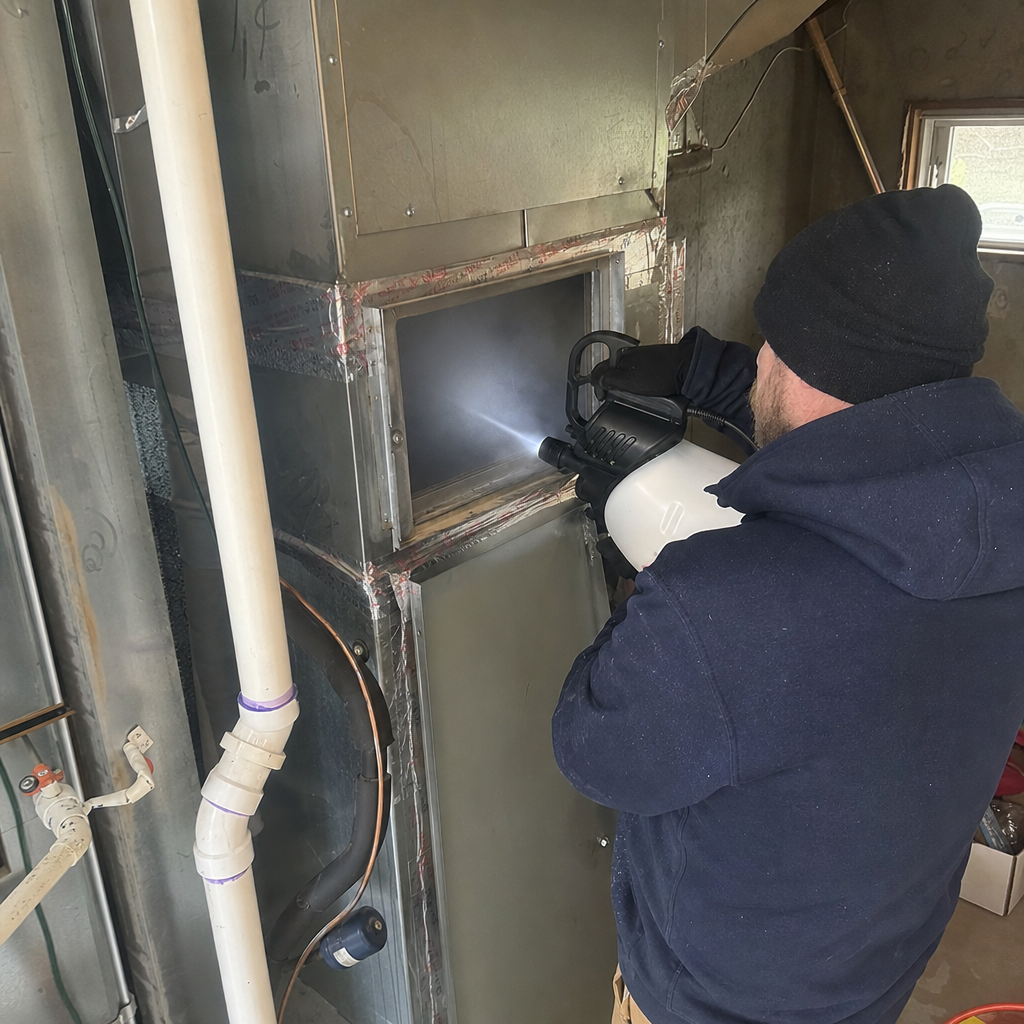
- Antimicrobial application: EPA-registered agents applied at proper concentration and dwell time using equipment designed for HVAC system delivery, not repurposed carpet-cleaning wands
- Post-treatment documentation: We show you what we found, what we did, and what to monitor going forward
This sequencing isn’t conservative upselling. It’s the protocol that produces results. Applying antimicrobial to dirty ductwork is like painting over rotted wood—the surface looks treated, the underlying problem continues.
Which Buffalo Homes Need Sanitizing Most (and Which Don’t)
Not every duct system warrants antimicrobial treatment. After eight years focused specifically on indoor air quality in the Greater Buffalo area, we’ve developed a clear risk profile for delivering the Best Air Quality & Sanitizing in Buffalo, NY.
Highest priority for sanitizing:
- Pre-1950 homes with retrofit ductwork through uninsulated exterior walls or crawl spaces, particularly in Allentown, Black Rock, and Riverside where we’ve documented the highest incidence of condensation-related mold staining
- Properties with any history of water intrusion, roof leaks, or basement flooding that may have affected duct runs
- Systems where visual inspection reveals active mold growth—not just dust discoloration—on interior duct surfaces
- Homes where occupants experience respiratory symptoms that correlate with HVAC runtime, suggesting airborne microbial contamination
- Post-renovation systems where construction dust has combined with moisture from wet trades (plaster, concrete) during the heating season
Lower priority:
- Post-1980 homes with properly insulated ductwork in conditioned spaces
- Systems that have been regularly cleaned and show no visual mold or moisture history
- Properties where the primary concern is dust accumulation rather than biological contamination
Charles makes this judgment call after he’s actually assessed the system interior—not during a phone pitch. This isn’t a sales upsell scripted into a franchise protocol. It’s a technical decision based on what we find when we open the access panels and look.
Air Duct Sanitizing Pricing in Buffalo
Our pricing reflects the two-stage nature of proper sanitizing: mechanical cleaning must precede antimicrobial application for either to be effective. We don’t offer sanitizing alone because we won’t perform procedures we know won’t work.
| Service | Price Range |
|---|---|
| Full air duct cleaning (standard residential system, up to 12 vents) | $350–$550 |
| Air duct cleaning + antimicrobial sanitizing | $625–$1,045 |
| Standalone antimicrobial sanitizing (not offered—requires cleaning first) | N/A |
| Dryer vent cleaning (add-on) | $125–$195 |
| HVAC unit cleaning (coils, blower, cabinet) | $225–$375 |
Variables that affect your specific quote: system size and accessibility, number of trunk lines and branch runs, severity of contamination, and whether we discover damaged or disconnected ductwork that needs repair before sanitizing is worthwhile. We provide upfront pricing after inspection, not after we’ve started the job. Estimates are free—call (855) 763-9868 to schedule.
Homes in Buffalo’s older neighborhoods with the complex retrofit ductwork described above often fall toward the higher end of these ranges due to extended labor time and the need for specialized flexible equipment to reach irregular runs. We’ve learned to quote accurately for these conditions because we’ve done enough of them to know what we’re walking into.
How Our Equipment and Process Differ from Franchise Operations
The “professional-grade equipment, not rental-grade tools” distinction matters for sanitizing specifically because application method determines efficacy.
Our Abatement Technologies systems are designed for indoor air quality contractors, not repurposed from carpet cleaning or pest control applications. They produce properly sized droplet distribution for HVAC system penetration, with controlled pressure that doesn’t damage flex duct or dislodge aging connections. The antimicrobial agents we use are EPA-registered for HVAC application—not general-purpose disinfectants relabeled for ductwork.
Charles’s familiarity with Honeywell and Aprilaire whole-house systems also means we can coordinate sanitizing with existing premium filtration installations you may already have invested in. If your home has an Aprilaire media cleaner or Honeywell electronic air cleaner, we factor that into our treatment planning rather than working around it blindly.
The owner-as-technician model means the person who assesses your system, selects the treatment protocol, and operates the equipment is the same person with eight years of focused IAQ experience. There’s no telephone game between sales and execution. No rotating crew of entry-level hires figuring out Buffalo’s peculiar duct configurations on your dime.
What to Expect During Your Service Appointment
When you schedule with Pinnacle Air Duct Cleaning Service Greater Buffalo, here’s how the process unfolds:
Pre-service: We ask about your home’s age, any water intrusion history, and specific symptoms or concerns. This helps Charles arrive prepared with appropriate equipment and access strategies for your duct configuration.
On-site inspection: Before any work begins, we open access panels and examine the duct interior with borescope cameras where needed. You’ll see what we see. If there’s no active mold or moisture damage to justify sanitizing, we’ll tell you—and recommend cleaning alone or, if the system is genuinely clean, no service at all.
Mechanical cleaning: Rotobrush contact cleaning for duct interiors, Nikro HEPA extraction for debris removal, with attention to the irregular runs and dead-end sections common in Buffalo’s retrofit systems.
Post-cleaning verification: Re-inspection to confirm surfaces are accessible for antimicrobial treatment.
Antimicrobial application: EPA-registered agents applied at manufacturer-specified concentration and dwell time using Abatement Technologies equipment calibrated for your system size.
Post-service walkthrough: Charles shows you documentation of what was found and what was done. We explain what to monitor and when to consider follow-up—particularly if your home falls into the high-risk categories for Buffalo’s condensation-prone ductwork.
Your air quality, start to finish. We don’t subcontract, we don’t upsell unnecessary treatments, and we don’t disappear after the invoice is paid.
FAQs
Proper air duct sanitizing service in Buffalo typically costs $275–$495 when added to a full duct cleaning—see How Much Does Air Quality & Sanitizing Cost? (2026 Price Guide) — Buffalo, NY for more detail, with combined cleaning-plus-sanitizing ranging from $625–$1,045 depending on system size and accessibility. We don’t offer sanitizing as a standalone service because antimicrobial agents can’t reach duct surfaces through accumulated dust and debris. For an exact quote on your home’s specific configuration, call (855) 763-9868—estimates are free.
EPA-registered antimicrobial agents can kill mold colonies on accessible duct surfaces, but only after mechanical cleaning removes the dust layer that shields them. Fogging treatments without prior cleaning, or products not specifically registered for HVAC application, won’t penetrate established mold biofilm. In Buffalo’s lake-humidity climate, we also need to address the condensation conditions that allowed mold to establish—otherwise, it’ll return regardless of what we spray.
No. Air duct cleaning is mechanical removal of dust, debris, and particulate using brushes, compressed air, and HEPA extraction. Air duct sanitizing is the application of antimicrobial agents to treated surfaces after cleaning is complete. Cleaning must come first—sanitizing dirty ductwork wastes your money and ours. At Pinnacle, we perform sanitizing only as a follow-up to thorough mechanical cleaning we’ve verified with visual inspection.
You need sanitizing if visual inspection reveals active mold growth, if you have a history of water intrusion affecting duct runs, or if occupants experience respiratory symptoms that correlate with HVAC operation. You likely need only cleaning if your concern is dust accumulation, odors from normal household sources, or routine maintenance in a system with no moisture history. Charles Rodriguez, our Owner and Lead Technician, makes this determination on-site after examining your specific ductwork—not over the phone. 160 homeowners rated us 4.9 stars for this kind of honest assessment.
Schedule Your Inspection and Get Straight Answers
If your furnace kicks on and you smell something musty, or you’ve never had your ductwork professionally examined in a pre-1950 Buffalo home, it’s worth searching Air Quality & Sanitizing Near Me in Buffalo, NY to find out what’s actually in there. We’ll tell you whether sanitizing makes sense, whether cleaning alone will solve your problem, or whether your system is genuinely clean and doesn’t need service at all. 8 years, one focus—indoor air quality in Western New York homes—and we don’t stay busy by selling treatments people don’t need.
Call (855) 763-9868 for a free estimate. Charles handles every job personally, and we’ll get you scheduled at a time that actually works.
Written by Charles Rodriguez, Owner & Lead Technician at Pinnacle Air Duct Cleaning Service Greater Buffalo, serving Buffalo, NY.